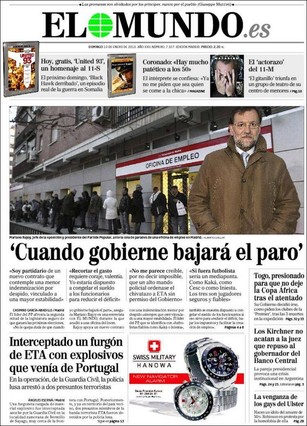
5778100 and still rising. 1737900 households where nobody is working. Unemployment in Spain is above 25% for the first time ever and it would be churlish not to acknowledge the key role played by that important labour market reform we got earlier this year. Still, with temporary contracts only taking around 90% of those few new jobs being created, there's clearly still everything to play for.
I did toy with the idea of continuing wordless blogging and just post the results widget from El País. The results will start coming in after 20:00 Spanish time.
Both of the regions voting today belong to that select group of comunidades autonomas in Spain (along with Cataluña and Andalucia) that set their own electoral timetable instead of having a common voting day. Neither Galicia nor The Basque Country have made it through the full four year term, although the reasons for early elections are different.
The outgoing Basque government had no choice but to call elections after the Partido Popular withdrew their support for the minority administration led by the socialist Patxi López. The expectation for today's election is that 'normal service' will be resumed and that the nationalists will sweep the board, probably taking the first two places. A return to nationalist rule would probably have been the case even without the fall in support for the two big national parties (PP and PSOE) provoked by their management of the crisis. The legalisation of parties linked to ETA's political wing means that the full nationalist vote will be reflected in the results, unlike the previous election.
This will leave Patxi López free to become the 'continuity' candidate for national leadership in the PSOE when current leader Alfredo Pérez Rubalcaba finally gets the message that he is not the future of his party. López will be in an even stronger position if the Catalan socialists get a drubbing in the forthcoming elections there. Carme Chacón almost beat Rubalcaba to the leadership but she will be damaged by a bad result in Cataluña. The next time a leader is elected there will be other contenders.
The effect of ETA's continuing truce and the legalisation of their political wing changes the balance of power in nationalist circles. The conservative PNV has always dominated the nationalist vote but now they are in competition with a strengthened rival. The margin between the PNV and Bildu will be important for the balance between those satisfied with regional autonomy inside Spain and those who favour a push for independence.
In Galicia the reason for early elections is simply political expediency on the part of the PP. The party has decided that with the economic situation continuing to deteriorate and the with the threat of imminent EU intervention to prop up Spain's finances, there is less political cost in bringing the elections forward. The PP may even conserve their majority in the Galician parliament, the PSOE shows little sign of electoral recovery and the Galician nationalists have been in disarray. If it comes off, the PP will feel fully vindicated in their consistent strategy of putting the party interest before anything else.
Barring surprises, the distribution of the vote may not change very much. What will be important is turnout, a big decline will be seen as something of a vote of no confidence in the big two parties. Some recent national opinion polls show them with little more than 55% support combined, when in happier times for Spain it would have been more like 80%. Some disenchanted voters will vote for the smaller parties, but many may simply opt for abstention.
Then, with the elections out of the way, perhaps Spain's government will come out of hiding although Rajoy's administration seems to have decided that is the best way to weather the storm. The decision on whether to ask for an EU rescue doesn't just depend on the electoral timetable, but as with the case of Andalucia earlier this year we have seen that the PP has no problem with concealing their intentions for electoral benefit. No-one in that party believes in falling on their sword for the greater good, power and the opportunities it presents are too tempting. As for those who suffer the consequences of this, ¡que se jodan!
It's now over 3 weeks since I last blogged on the subject, but the crisis over the bailout of Bankia rages on. As each week passes we learn more about the colossal disaster that the bank has become. The amount needed to save Bankia seems to rise almost every day and the disastrous handling of the issue by the government came dangerously close to provoking a run on deposits in the bank.
More than just being another episode in an ongoing financial crisis, the Bankia situation does show every indication of being a full blown scandal. How is it that a bank which announced profits of millions of euros and which was still talking of making new acquisitions just a couple of months ago has been revealed to be a wreck with such enormous losses?
The government is doing everything it can to avoid any kind of investigation into what has happened, criminal or otherwise, and is getting some help from the PSOE. The PP have tried hard to put all the blame on the outgoing governor of the Banco de España, who does deserve his share of criticism. But then we are still left wondering what exactly Rodrigo Rato and friends were doing in return for the millions they took out from presiding over the bank?
As usual in these situations it's the little people who take the hardest hit. Given the lack of interest from the big investors, Bankia mobilised its whole commercial network to sell shares to its own customers. I know personally of one case where €3000 was simply deducted from an account without consent in return for what would now be a virtually worthless shareholding. The 'mistake' was of course corrected, but I wonder how many other cases there were.
The PP have blocked the possibility of parliamentary investigation, even though they could easily use their parliamentary majority to convert any investigation into a circus. What should be happening is a full criminal investigation to examine what really happened inside the bank. Best wait for that sitting down, as the Spanish like to say.
It says an awful lot about the way this government operates that the announcement of how much public money Bankia needs was made by the newly appointed president of the bank, with a figure way above anything which had been suggested by government ministers. Then there is the (deliberate?) confusion over the way in which the bank will be rescued. True to their ideology, the government is making it fairly clear that there will be no general public benefit in return for €19,000 million of help.
The only response to criticism of their handling of the crisis has been attempts to distract public attention. Anything will do, the spat with Gibraltar, the chorus of whistles that greeted the national anthem at the Spanish cup final. All with the help of servile newspapers who find day after day that Bankia is not a significant enough issue to make the front page.
Spain's government is being crushed by the weight of its own mediocrity and inability to respond to the situation. After Mariano Rajoy's surprise press conference the other day, there are now not so many criticisms of his refusal to explain events. Because it has become evident that he doesn't have an explanation to offer, merely a collection of recycled cliches. The problem with this government is that they have the capacity to make the outcome of the crisis even worse for Spain because of their determination to politically manipulate the situation the country faces.
Some will be happy at the suggestions that the EU is now demanding even more cuts in return for possibly relaxing a budget target that nobody seriously believes to be achievable in the first place. However, the argument that this is a crisis of public debt looks more and more frail every day. It's about public resources being used to prop up the private sector. There are some absentees from the list of those accused of mismanaging the banking crisis, because those who control Spain's biggest banks have been instrumental in driving the disastrous strategy. Happily, not everybody is taking this situation lying down.
The news yesterday that Bankia is going to be bailed out by the Spanish government has put the stability of the Spanish banking system back at the centre of the country's ongoing crisis. In the process the government has managed to simultaneously create a certain degree of nervousness about the safety of deposits with Bankia as well as significant outrage over the proposed bailout - which could involve as much as €7000-10000 million of public funding. We don't yet know how a government which previously claimed it would use no public money to bail out the banks is going to manage the turnaround, Friday is the bad news day. The commitment on no public bailouts is now just another of those broken promises which sees virtually nothing remaining of the few concrete commitments that Mariano Rajoy made prior to the elections.
The surprising part of the announcement was that it came coupled with the removal of Rodrigo Rato as Bankia's president. Rato, at least until yesterday, was regarded by Partido Popular supporters as an economic wizard; based on him having been economy minister at the start of Spain's economic bubble. More recently he has just cashed in nicely on running the bank which holds a huge amount of devalued construction related assets and bad loans. Thanks of course to Rajoy's decision to place him as boss of Caja Madrid, Bankia's main component. Which makes it even more significant that such a powerful figure in the PP should be removed by a government of the same party. Because he was removed, it seems. The situation is made even more ironic by the fact that the move against Rato was spurred by a critical report from the IMF, Rato having been director general of that body until he walked away from that job before the shit hit the fan.
The whole Bankia situation stinks, and exposes in the process some of the false narratives that are used to justify the less well off sectors of Spanish society paying the brunt of the economic crisis. We were told that the fusion of the regional savings banks (the cajas) and their conversion into banks was a necessary step to clean up the mess left by the end of the construction boom. The cajas were bad because they are not run by professionals, was the story. Some story, because Bankia is now a bank resulting from this fusion process and all that has been created is an even bigger and more expensive monster. By the way, if things get really bad then don't expect the fund supposedly guaranteeing deposits to help account holders. That money has already been systematically ransacked to pay for a series of pointless fusions.
What makes things worse is that Bankia has already received significant public funding, in addition to what would turn out to be very expensive state guarantees if the bank were to go under. Funny, isn't it, that when we are told no money is available for public services the situation changes so quickly when it's the financial sector that comes calling? Especially when we were repeatedly assured that the problems were being solved. Don't go asking about the regulatory role of the central bank. Spain's Banco de España has been largely absent as banks and cajas have struggled to survive. Largely because the governor of this institution, Spain's highest paid funcionario Miguel Ángel Fernández Ordóñez, has been far too busy in recent years lecturing ordinary Spaniards on how well they have been living and why they need a good labour market reform to sort that problem out.
But at least we don't need to feel too sorry for Rato, he usually manages to land on his feet. It seems fairly likely that the economic terms of his departure will not be those set in the latest labour market reform for getting rid of employees. It was his economic model that failed and led the country into this crisis, the structure of the banks makes little difference to the outcome when the dependency of the whole sector has been on building ever greater numbers of houses year after year based on the assumption of endless credit. Bankia is still stuffed full of PP appointees and the solution adopted to allow them to continue in their comfortable positions is unlikely to be favourable to public finances. In this situation it is Rato that has been left, perhaps to Rajoy's satisfaction, looking like a greedy banker.
It's become a common feature for almost all governments with popularity problems to blame their troubles on poor communication rather than their policies. Spain's government is no exception to this, with the governing Partido Popular preparing a publicity campaign to attempt to justify Spain's disastrous economic course. Many of the PP's own supporters are deeply unhappy with some of the government's decisions, perhaps not surprising when you consider that Rajoy's administration has now broken almost every promise that the PP made before the elections. Party supporters are left trying to defend everything which they so loudly opposed when in opposition.
There is another aspect to the PP's strategy. The last few weeks have seen a growing chorus from government friendly media for something to be done about the state television company RTVE. Not having much of a democratic tradition means that Spain's right is unable to understand how a state owned broadcaster isn't directly supportive of their government. Any report which smacks too much of pluralism or which doesn't toe the party line is automatically accused of anti-PP bias. The right wing got their way last Friday, as the government changed the law concerning the appointment of RTVE's governing body so that they can put the corporation under their control.
It would be going too far to describe RTVE as being independent, but the situation that existed until Friday at least meant that a single party couldn't impose their political control. Zapatero's administration had changed the law in such a way that that two largest national parties had to agree a consensus candidate for the presidency of RTVE, and neither party could have an outright majority on the governing board. That goes out of the window now, if there is no agreement on a consensus candidate then the government can impose whoever they want with their parliamentary majority. The pretext of austerity has been used to remove representatives of organisations like the unions from the board, allowing the government to appoint the majority.
This threatens to return us to the Aznar era, when RTVE news delivery was kept under tight political control. Although it's unlikely that news bulletins will begin, as they invariably seemed to do in Aznar's time, with the words "el presidente del gobierno ha dicho". Rajoy still seems to be averse to any kind of communication at all, although a more government friendly broadcaster will no doubt show the great leader delivering declarations without of course experiencing anything so uncomfortable as a journalist asking him a question he hasn't been prepared for. This is a move towards the Telemadrid model of television as a political tool, and those RTVE journalists who have demonstrated worrying signs of independence will now be wondering what future they have.
Despite the moves to control RTVE, it's still unlikely that Spanish television will be the chosen platform for breaking the really bad news. For that sort of thing you really need to be a reader of the Frankfurter Allgemeine, or perhaps occasionally the Wall Street Journal. Economy minister Luis de Guindos announces the government's measures first to overseas media, and then eventually the government gets around to telling the Spanish people what is about to happen to them. The latest example was with the additional health and education cuts which were announced first in the German paper. At least the sick can be reassured that when they have to pay more for their medicines it's really just a problem of communication.
Mariano Rajoy, the man who proudly proclaimed in January that he would always show his face and never hide from the crisis, left today's Spanish senate session by the back door to avoid having to answer any questions from journalists. This on a day when Spain has again been battered by the markets, to an extent that has previously provoked the dreaded EU "rescue" for other countries. All of which comes the day after an increasingly panicky government tried to placate the markets by throwing them a bone in the form of €10,000 million worth of additional cuts in Spain's health and education services. Because, as we all know, health and education services cause tremendous problems for a modern, 21st century, economy. Just as they did in the 19th century. These are services which have gone, in the space of just 3 months, from being "untouchable" to being top priority for cutting. The PP made very few concrete commitments, but they have already broken almost all of them.
Rajoy seems to have very quickly achieved the difficult task of making Zapatero look like a far sighted, long-term strategist by comparison. Those who so freely accused Zapatero of constantly improvising are now all over the place, although they maintain their ideological focus. Hence the offer of cuts in education and health in response to all the attention focused on the financial sector and its dodgy finances. The latest cuts figure was announced yesterday buried in the third paragraph of a press release, and with no indication of any sort of where the cuts are to be made. It's had no effect of any kind when it comes to improving Spain's situation, nor was it ever likely to. But now the government has created a situation where the cuts will have to happen, or they will be punished for not doing them.
This seems like a suitable time to recall how little Spain's public services have to do with the crisis here, which is above all a problem of construction related private debt. From the creator of the admirable Españistan we now get Simiocracia.
One of the comfort blanket beliefs of Partido Popular supporters as they finally start to come to terms with the true nature of Spain's crisis has been that their government is doing things properly and that the reward for this has been a decline in market pressures on Spanish bonds. Well they've just lost their blanket. Today's not very successful bond auction shows that once again it's the turn of Spain to be pushed a bit further along the path which the Irish, Portuguese and Greeks have already taken. The recent lull in such pressure has had everything to do with the "barra libre" policy adopted by the European Central Bank in terms of giving huge sums of money to the banks whilst of course doing nothing to help the countries most affected by the debt crisis.
But surely the Spanish government is doing everything asked of it, supposedly what the markets want? Leaving aside the almost incidental 0.5% difference between the deficit target the Spanish government wanted, and the one they have been given by the European Union. The much vaunted labour market reform, which is already helping Spain progress towards 6 million unemployed, and now a budget which aims to slash 3.2% off the deficit in a single year. It is always either too little or too much. Usually the former, but once it becomes clear that Spain's chances of economic recovery are being fatally crippled by these measures then the excuse for making it ever harder for the country to finance its debt will become the poor prospects for economic growth. It's this wonderful Catch-22 that allows the roulette wheel to keep on spinning.
So the idea that slashing public spending to cut the deficit is going to let Spain escape is lacking any credibility. Even less credibility can be given to the arguments from the government that this lays the basis for economic recovery. Apart from this, it's extremely unlikely that the government will get anywhere near the deficit target this year. I haven't seen one serious analysis of Spain's situation which suggests it is possible for the government to achieve such a big reduction of the deficit in the midst of a recession. The government doesn't believe it, hence their strenuous efforts to change the target for this year. The combination of spending cuts and tax increases announced in the budget is the minimum amount (a mere €32,000 million) needed to get to the target, but the downward spiral that these cuts set off is more likely to increase the deficit than reduce it.
The IMF estimate of a 1.7% GDP decline for the Spanish economy this year is already outdated. Revisions of these estimates are almost monthly events these days. With the latest measures announced in a budget that was delayed for electoral reasons, it is reasonable to start thinking in terms of a 2.5-3% decline for 2012. If, as may well happen quite soon, the response to the failure of the first package is more of the same then it becomes distinctly possible for this provoked recession to match that which we already saw in 2009. Even some of those who blindly followed the dogma and assumed this madness was bound to work are now revising their positions when faced by the bleeding obvious. Not that they acknowledge the shift. All this pain to achieve nothing but further destruction of productive capacity can in the end only be justified with a narrative that distorts reality beyond all recognition.
Much of the damage to be caused by the cuts is still to be revealed, almost half of the cutbacks have to be made by the regional governments who are the authorities responsible for education and health services. The way the government has presented the new budget makes it all seem relatively painless, but hidden in the details are measures which can only make life harder for many. Despite the talk of a general percentage cut across ministries, some of these are doing much worse than others. International aid has been brutally slashed, public works investment takes a huge hit and the money spent on scientific research is also heavily cut. Out the window goes the budget dedicated to assisting job seekers, and that which assisted young people in finding somewhere to live. We wouldn't want anyone to start thinking that Rajoy's government has an economic model in mind that isn't based on cheap labour, concrete and tourism.
The government claimed that it has no intention of cutting public sector salaries, although the decision to freeze these is in effect a cut in living standards. Not that prices are likely to fall as a result of the budget, RENFE will have to fill the gap left in their funds with significant fare increases for trains. Both the public television service and state support for the cinema industry are seeing significant reductions. Support for the most vulnerable who receive support for being dependent on others for their care has also been cut back. Some measures are a bit perplexing. If the government intends to maintain unemployment benefits as they claim then it is odd that they have assigned less money for this purpose at a time when the numbers of the newly unemployed have been increasing again.
The sacrifice is far from equally shared. The royal family gets a reduction of just 2%, something the king will probably forget to mention next time he makes one of his "we all have to pull together" speeches. The interior ministry also gets off lightly, those police helicopters, rubber bullets and gas canisters are expensive and are needed to dissuade people from protesting against their situation. The defence budget also came out relatively well. Then comes the star proposal. A tax amnesty for those fraudsters who pocketed so much of the profits from the boom years. They can now regularise their situation paying just 10% with no questions asked. Not that many of them will, the way things are going they almost certainly have their euros stashed outside of Spain. Meanwhile, the honest taxpayers who have had their income tax increased earlier this year are left paying a much higher percentage than the crooks.
They say the champagne was ready to be opened in celebration on Sunday at the headquarters of the Partido Popular. Such was the confidence that they would win Andalucia's regional government with an overall majority. That's what the opinion polls prior to the final week of the campaign had all indicated, and it is said that the private polls in the last few days before voting also carried the same message. This was going to be the jewel in the crown following the conquering of power at national level, Spain's biggest regional government and the last remaining bastion under majority PSOE control. Not only that, but the popular mandate to be gained in Andalucia was going to be used as vindication for the agressive policies of the government - proof that the Spanish understood the need for tough measures.
But it didn't work out. Sure, the PP emerged as the largest party in terms of votes, something they had never achieved before in Andalucia. Barring dramatic events, it's not enough. They are 5 seats short of a governing majority and the PSOE can govern again if they obtain the blessing of Izquierda Unida (IU), who doubled their representation in the Andalucian parliament. When a similar situation occurred in Madrid in 2003, 2 of the PSOE deputies were 'persuaded' not to support their party in the crucial vote but in this case such a solution would be a bit more challenging. Despite the attempts by the PP to spin the result as victory their faces betrayed them and the party at their headquarters never got going. They entered the week of a general strike and what promises to be an extremely tough budget without the trophy they had hoped for.
For once the abstention didn't come from the voters on the left. At least not all of it. The PP lost around 400,000 votes in Andalucia compared to the general election, whilst the PSOE made a timid recovery from November's disaster and some of their former disillusioned supporters turned further to the left and opted for Izquierda Unida. The regional president, José Antonio Griñan, has seen his decision to give Andalucian voters a taste of the PP in office vindicated. Had the election coincided with the general election Griñan would almost certainly have been booted out. Now the question is what sort of agreement Griñan can make with Izquierda Unida.
IU have already made it clear that they favour keeping the PP out of power. It's very unlikely that there will be a repeat of the situation that occurred in Extremadura last year where relations between the PSOE and the local IU leadership were so bad that the latter permitted the PP to take office. Such a situation is unthinkable now, with a PP national government implementing aggressive right-wing policies. Even so, IU should play hardball over their support, it can't be a case of business as usual. Andalucia has some possibility of demonstrating that alternatives exist to destructive slash and burn economics, and IU should not sell their support cheaply. The option of letting the PSOE govern in minority seeking approval for their measures shouldn't be discarded.
The Andalucian result has had an important psychological impact. The PP had behaved in recent weeks with incredible arrogance, very much as if they were the "dueños del cortijo". Even though their victory in November was as much a result of rejection of the previous government rather than support for full blooded right-wing policies, the government has behaved as if they have popular support for everything they want to do. Just as they did when Aznar got his majority in 2000. Now things don't look quite so simple, and the honeymoon is over for Rajoy. With Andalucia, and possibly Asturias, in opposition the political panorama changes.
The result in Asturias has been overshadowed by that of Andalucia, but it is also interesting. The PSOE emerged as the largest party, with the right-wing vote split between the PP and FAC, the formation of the renegade Cascos. The PP came third in the region whilst the decision by Cascos to call another election has not done him much good. Today's count of the emigrant vote has also changed the outcome with the PSOE gaining an extra seat at the expense of FAC. This leaves the PSOE combined with IU on level terms with FAC and the PP. The casting vote could lie with the solitary representative of UPyD who have previously stated they would support the party with the most votes in such a situation. Their principles, such as they are, may yet be put to the test in Asturias.
I haven't found much time for blogging recently, but at least I can maintain this blog's tradition of posting election results from Spain via the handy widget from El País. Both Asturias and Andalucia are voting today for their regional governments, although the early indications on participation suggest that many people in both regions are not that enthusiastic about casting their vote. The participation figures released earlier today showed Andalucia 10 points down on the previous elections, and Asturias 8. The received wisdom is that low participation favours the right, as their voters are usually less likely to abstain.
Most of the attention will focus on the Andalucian vote, where the governing PSOE face a serious possibility of losing power after 30 years of uninterrupted control. Affected by the reaction against Zapatero's government, by weariness after so long in power, and by a serious corruption scandal, the PSOE will regard just a failure by the Partido Popular to obtain an overall majority as a major success. The Andalucian vote would have coincided with the national elections if Zapatero hadn't decided to go for an earlier election.
The PP will obtain a huge boost if they win Andalucia, their candidate Javier Arenas has been a serial loser of elections in this region. It will give them unprecedented power in the country, as they already control a clear majority of the other regions and form part of a governing alliance in others. Apart from anything else the Andalucian election has been the primary reason why we still don't know what cuts the national government intends to implement in order to attempt to meet the crazy deficit reduction target for this year. With the elections out of the way then reality will come rushing up fast behind.
Asturias is holding elections just 10 months after the previous ones. This is a result of the failure by the former PP secretary general, Francisco Álvarez Cascos, to form a stable government there following his victory in May last year with his breakaway party. Cascos represents everything that is bad about Spanish politics, although it's very unlikely that he will do as well today as he did last year. The region could still be left without a stable government as it is not likely that any single party will win a majority. No further elections are allowed for at least a year if deadlock is the result, and as Asturias is one of those regions that doesn't set its own election date any government that results will have no more than three years in power.
All seems to be calm. Mariano Rajoy announced last week that the Spanish government was relaxing its deficit reduction target for 2012 and....virtually nothing happened. There have been some token noises of disapproval from Brussels but nothing yet which seriously suggests that Rajoy's apparently unilateral move hadn't been quietly agreed with those who are really in control of the Spanish economy. We'll have to wait and see how events develop, but if I was running the show in Brussels and wanted to allow a couple of countries to relax slightly their targets without encouraging everyone else to do the same, then this is probably how it would be done. It even allows Rajoy to pretend to be in charge.
Rajoy's justification for the move was of course the massive overshoot on last year's deficit target. There is understandable suspicion about the 8.5% deficit figure from last year. Much of the responsibility for this lies with the regional governments who, oddly enough, were more or less on target at the end of the third quarter only to veer wildly off it in the final three months of the year. Given that most of these governments are now controlled by the Partido Popular it is suspected that the figures have been manipulated to exaggerate last year's deficit. There are obvious political benefits in doing this. Firstly, it permits the PP to apportion more blame for the deficit onto Zapatero's government whilst at the same time bolstering their case for relaxing this year's target.
Politics is everything with the deficit at the moment. Despite being persistently asked by the EU to present a budget for 2012, the government has managed to defer this until after the Andalucian elections later this month. Then will come the really bad news. If anyone thinks that the pressure is off because of the change to the deficit target then they could not be more wrong. The government still needs to deliver as a minimum another reduction in spending equivalent to that which they already announced at the beginning of the year. These are cutbacks that go way beyond anything that Zapatero's government was required to deliver in order to try and cut the deficit by 2.7% in a single year.
They've changed a completely unattainable target for one that is just simply unlikely. The reason being that once you start making savage cuts to hit a deficit target then the effects of these cuts on tax income and economic activity in general mean that you have to cut even more just to try and hit the same target. This is the full application of what we can call, in a bid to assist future historians investigating the disaster, The Cycle of Stupidity. So in addition to the headline cuts figure to formally meet the reduction target, there will be an extra hit. The total cuts figure in the end could still be close to the €40,000 million that was seen to be necessary to meet the previous deficit target. The overall reduction if last year's budget target had been met would have been less than the one we will still get this year. Even though it's very unlikely to work.
I still see some occasional talk of growth resuming in the last quarter of this year and you have to seriously question the judgement behind this. With the government now accepting the IMF's estimate of a 1.7% decline in the economy, and bearing in mind that these estimates change for the worse every few weeks at the moment, just where is that growth going to come from? It would be nice to think that Rajoy's shift on the budget meant that common sense had finally told, but it seems to be only a tentative step towards dealing with reality. Bear in mind that job losses don't really cease until you get to around 2%+ growth and 6 million unemployed in Spain is now looking inevitable. But not, of course, unavoidable.
I went to the cinema yesterday and in the toilets I saw a xenophobic piece of graffiti inviting British and American language teachers to go home. The graffiti was notionally in defence of public education but had of course missed the target. It's the Condesa de Murillo who is determined to further lower education standards by seeking to ensure that children are taught in the cheapest possible way in a language that most of them barely understand. To that end she wants to use native teachers as a weapon in her battle with the Spanish teachers. Unfortunately, the second part of the graffiti fatally undermined the case the author was trying to make. It went something like this (in the original English):
Next weekend sees the 8th anniversary of the Madrid bombings. In many respects it will be a normal Sunday. Football matches will of course be played, many restaurants will be open, theatres and cinemas too. It's really business as usual, you could argue about whether that's a good or a bad thing - but that's the reality. There will also be the institutional ceremonies to mark the anniversary. And there will be the habitual attempts by sections of the right-wing press and the Partido Popular to use the bombings as a political weapon against their opponents, and if possible to earn a bit of money from it in the process.
This latter tradition has already begun, with a noisy campaign launched against the decision by Spain's trade unions to hold fresh protests against the government's labour market reform on March 11th. Government ministers and the Delegada del Gobierno in Madrid have claimed that the decision to hold the protests on this day shows a "lack of respect" for the victims. But surely, you'll be thinking, such a fuss is being made because it's not normal for demonstrations with a high political content to be held around the time of the anniversary of the bombings? Ah well, that seems not to be the case. It all depends who is doing the organizing. Did you spot the future prime minister?
All the talk about respecting the victims, coming from these people, is just a bit too much to take after 8 years of fabricated conspiracy theories. The largest association of 11M victims has already publicly disassociated itself from these pathetic attempts to use the victims of the bombings as a battering ram against the trade unions. But for those in the PP who like to claim to speak on behalf of the victims these people simply don't exist. The same victims association refused to swallow any of the conspiranoico nonsense that we have had to put up with for so long, with the result that they were denied public funding by those governing Madrid.
Perhaps it was their refusal to use such public funds to organise fraudulent demonstrations against Zapatero's government that has always counted against them, as they preferred to use their resources to assist their members. It's as if they don't exist. Alongside all of those victims who still carry shrapnel in their bodies as a reminder of that fateful day in 2004. The conspiracy theorists insist that no shrapnel was used in the bombs that exploded, so that's a another group of victims whose very existence must be denied. With the greatest possible respect, you understand.
Now I've never been a huge fan of those who have claimed that the Spanish right is somehow different from its European counterparts. Largely because such claims usually involve exaggerating the democratic credentials of the right in other countries to make the point. However, in the case of 11M it is the absolute absence of any kind of ethical baseline that does seem to mark a difference. I'll try to be fair, there are a few (far too few) on the Spanish right who find this repugnant exploitation of 11M to be too much and some have said so. The problem is that they are like voices in the wilderness, almost unheard.
You look for some sign of someone saying "perhaps we've gone a bit too far this time" but it's just not there. The 'todo vale' ruthless cynicism that we see suggests that life in a moral vacuum doesn't seem to affect the health of those who live in it at all. Just their judgement. It's sad and tiresome. Sometimes I find it hard to believe that I'm still writing posts like this one after so many years of the same cynical, manipulative shit from these people. Then the new conservative attorney general throws a meaty bone to the hungry hounds by opening a formal investigation based on another piece of pseudo journalism from Libertad Digital. There will always be a few more bloodstained eurillos to be squeezed from inventing fake news stories, and a few more petty political points to be scored from Spain's worst ever terrorist attack. All because the subsequent election didn't turn out the way they wanted. That, you see, is what they call respect for the victims.
The closure last week of the paper edition of Público meant the end of the battle to preserve what may well turn out to be the last general interest printed newspaper to be launched in Spain. Público had never been profitable even though it did manage to establish a place in the newspaper market in its short existence, the paper was only launched in 2007. Indeed, it was almost unique amongst the press in Spain because the paper showed increasing sales at a time when the trend for most Spanish papers is very much the reverse.
I bought it and liked it. There was definitely a market for a paper more to the left of the almost centrist positions generally adopted by El País. The problem was that launching a new daily newspaper in the age of the internet is a risky business. The crisis has had a savage effect on revenues from advertising that were already suffering from the shift of much of this revenue to the web. The strange thing is, given the times in which it was founded, is that the owners of Público didn't invest more time and resources on establishing their web presence.
Público was of course part of a wider project, the attempt to build a media group that would rival the power of Prisa, the owners of El País. This project was headed by Jaume Roures, and the same people were behind the launch of the television channel La Sexta; which has now been swallowed by the owners of Antena 3. The length of the crisis, and perhaps the lack of any indications that it will soon be over, have meant that sinking more money into media and publishing operations no longer makes sense for Roures.
It was always slightly odd that a paper controlled by a wealthy media mogul like Roures would gift its readers with books by Marx or Lenin, although perhaps Friedrich Engels wouldn't have agreed with that appreciation. Now the employees of the paper wait to see how many of them will survive the closure, as the web edition of Público is still supposed to continue operating. Then there is the question of how those who will be fired will be compensated. It will cause considerable bitterness if Roures tries to use the newly reformed labour legislation to get away with reduced compensation for those sacked.
There has been some undisguised glee at the closure in some sections of the right-wing press, celebrating a situation where only one left of centre national newspaper (El País) remains compared to four (ABC, El Mundo, La Gaceta and La Razón) on the right. These people are not, of course, those who will necessarily laugh last. There is little special about the case of Público and the situation of the rest of the press makes it highly likely that there will be further closures. I will be surprised if the four right wing papers still exist in their current form in two years time. Surely those who criticise public subsidy so frequently are not secretly desiring a bit of the same?
Vocento, the owners of ABC, and Prisa have both recently announced huge losses and the pressure is very much on in these companies to continue to cut staffing and reduce costs. El Mundo's Italian owners have written off a huge amount of losses from the Spanish editorial group and the paper has extended what were supposed to be temporary measures reducing salaries and costs. These are companies that have some financial cushion, over at the smaller ultra conservative Intereconomía the losses were already significant for 2010 and can be expected to be substantially bigger for 2011. Any viewers of their TV channel who foolishly handed over money in response to last year's appeal might as well just throw their cash into the deepest hole they can find; the result will be the same.
Perhaps fusions or a wealthy and carefree sugar daddy might help to save some of these titles but the situation is unsustainable as it currently exists for one simple reason; the economic model that is needed to sustain a newspaper in the age of the internet has still not been found. Quality of the product is declining in those cases where there was any to begin with. The end of printed editions for many papers is no longer a distant prospect, even in better economic times the revenue lost to internet is not going to return. This is a something that should be particularly worrying for those papers with the highest average age of reader (La Gaceta and La Razón in Spain), they are the ones who will lose more customers even if the magic solution for news delivery on the web is found.
Spain's ruling party, The People's Party, held it's 17th Congress last weekend as hundreds of thousands of Spaniards took to the streets in an unprecedented show of defiance to the hardline regime. The congress saw the re-election of Kim Jong Rajoy as party leader. Regime mouthpiece PPravda reported that Kim Jong Rajoy, normally referred to as the Dear Leader, was endorsed by an overwhelming 161% of party delegates. The paper compared this to the previous congress in 2008, when the party's leader only received the support of 142% of those attending.
Speeches at the congress focused overwhelmingly on the dire economic situation of the country. Kim Jong Rajoy, in his acceptance speech, warned the country of hard times that lie ahead before leaving to take his afternoon nap. A controversial policy of sacking 80% of the Spanish workforce was presented to delegates as an important measure to assist job creation, under the slogan "We must first destroy in order to create".
A new four year plan to revitalise the moribund economy was also presented.
Bold new production targets have been set for key industries, notably those producing tear gas canisters, rubber bullets, police batons and other crowd control materials. Other key modernisation policies include the mandatory use of shackles in the workplace. Party officials pointed out that these shackles were made from highly resistant plastic rather than the more traditional iron. Another sign of the country's technological prowess, they claimed. Important changes were also announced for workers salaries. Delegates at the conference unanimously supported a motion describing the monthly salary as an outmoded, petit-bourgeois concept.
One notable absentee from the congress this time was Francisco Camps from Valencia. A hero of the previous congress, which was held in Valencia, Camps has since fallen into disgrace following the discovery of unspecified irregularities at the Number 4 Suits R Us factory. Kim Jong Rajoy left almost immediately following the congress for talks with the regime's key allies in the Eurobloc Pact. German and French leaders provide occasional assistance to prop up Kim Jong Rajoy's regime under the strict condition that the only beneficiaries of this aid should be the banks.
When Mariano Rajoy announced his new government in December there were some who chose to see it as a selection of moderate, almost technocratic, ministers. The reality is that Mariano made his ministerial choices on the basis of loyalty to Mariano above all other considerations; apart from the now obligatory inclusion in a senior position of a banker. Only two months later, the idea that this is a moderate administration is already very difficult to sustain. Take the case of the justice minister, Alberto Ruiz Gallardón. As mayor of Madrid he was of course rightly famous for having bankrupted the city and for having won a gold medal for failed Olympic bids. But he was also seen as a centrist politician capable of reaching out to those voters who disliked the fundamentalist, taliban wing of the Partido Popular.
The trick worked well for quite a few years, but it was just a trick. Gallardón's mask started to slip before he made the leap to national politics, the papal visit last summer saw him enthusiastically joining the competition to hand over as much of Madrid as possible to the Pope and his pilgrims. Now installed as a minister, it is Gallardón who will steer through what promises to be a thoroughly reactionary abortion law reform. Quite possibly taking us back to the position of the 1980's when women wanting an abortion and health professionals could never be absolutely sure that what they were doing was legal. Just the sort of precarious ambiguity that suits the PP on issues like this.
Gallardón, who has never hidden his ambition to lead the PP and who prospered under the patronage of eminent Franco-democrat Manuel Fraga, is now perhaps more concerned about winning over those still to his right.
So, yesterday, it was Gallardón who led the charge in defence of the brutal police violence we have seen in Valencia in the last few days. Fully equipped riot police beating up school kids has led to some shocking scenes, but the moderate Gallardón sees none of this. Instead he would have us believe, alongside the ever more servile right-wing press, that it is all the work of anti-system radicals intent on attacking the police. Oddly enough, as the riot police were withdrawn yesterday, there was an outbreak of entirely peaceful protest in Valencia. It's almost a perfect portrait of the way that region is being run, kids and their parents who protest about having no heating in their schools get beaten by riot cops whilst the corrupt political leadership who don't pay the heating bills continue to go peacefully about their business.
It's fairly clear that the new government has let the police off the leash in dealing with any protests against the severe cutbacks being implemented by Rajoy's administration. In Madrid Esperanza Aguirre was threatening to form her own regional police force last year, as the then PSOE administration refused her repeated requests to crack heads in the Puerta del Sol. In compensation for not getting her own private police force (a truly frightening prospect), she instead got one of her people installed as the Delegada del Gobierno in Madrid, the government's local representative. The change is already being noted with the police putting any meetings of the 15M movement held in the Puerta del Sol under intense pressure.
The excuse for this pressure on protest movements is that such actions have not been authorized by the government. It's a common PP refrain that the 15M activities are illegal because they do not ask for permission. Back in the real world there is actually no legal requirement in Spain to ask those in power for permission to demonstrate - just as well! The Spanish constitution guarantees the right to assembly and there is only a legal requirement to communicate the intention to meet if the event in question affects the use of areas of public transit. Failure to communicate this isn't even a serious crime, the penalty would be a fine. But for the right it's sufficient excuse to send in the riot police, and to use the law when it suits them to use it. Sports fans who come on to the streets to celebrate their team winning a trophy are unlikely to be baton charged by the police.
Occasionally, very occasionally, the police are forced to account for excesses. With huge media coverage of the violence they used against peaceful protestors in Barcelona last year a judicial case against the senior officers responsible on the day is leading to the possibility of a trial. But will it matter? In 2009 five Catalan police officers were found guilty of mistreatment and illegal detention. Oh, I almost forgot, they were found guilty of torture too. The details of the case are appalling. Last week the PP government pardoned them and they will soon be back on duty 'upholding the law' with no penalty of any kind. How safe does that make you feel? The more you hear the vacuous rhetoric about how we are all equal before the law, and we hear it a lot these days, the less likely it is to be true. Meanwhile, let's not forget that the moderate Gallardón is STILL on the left of his party.
If you want to know how life was before the internet, you don't really need to travel through time or even go any further than last Sunday's Goya film awards in Madrid. For the president of the Spanish film academy the web is still a thing of the future, not of the present. Just as well for him, then, that one of the first acts of the Rajoy government was to approve the regulation of the anti piracy Ley Sinde. Spain's cinema industry can still continue to regard the internet as the enemy, rather than as a business opportunity.
The trouble is that the new government may not be helpful in other ways. There were several references in the ceremony to the important role played by the national television company, RTVE, in the production of many Spanish films. That could well be about to change, the state broadcaster is in deep financial trouble with the future of many of its flagship programmes in doubt. The Partido Popular has little sympathy for the Spanish film industry in general, some remarks in speeches at the ceremony about not forgetting the victims of Franco's repression or in defence of public education were unlikely to go down well with the PP politicians present.
As for the awards themselves, the big winner this year was Enrique Urbizu's thriller No habrá paz para los malvados (No Rest for the Wicked). The result was a little unexpected, this year's ceremony was supposed to be one of reconciliation between the academy and Pedro Almodóvar, the latter having decided to show up this time in the expectation that someone would scream "Peeedrrro" from the stage when the award for the best film was handed out. But La piel que habito (The Skin I Live In) didn't do particularly well as some of the major awards went to Urbizu's film.
No habrá paz para los malvados is one of the few nominated films that I've managed to get to see this time. It's not a bad film, and Jose Coronado was a worthy winner of the best actor award for his portrayal of the corrupt cop attempting to deal with the only living witness of his crimes. But in general I found the film a bit difficult to follow, nor is the idea behind it so original for it to stand out. I can't compare it with the Almodóvar film, because the accumulated prejudices of the past few years (with the sole exception of Volver) mean that Pedro's latest release usually ends up near the bottom of my list of films to see.
Yesterday I went to see Iciar Bollaín's latest film, Katmandú un espejo en el cielo. I like most of her work but had lower expectations of this story concerning the attempts of a Catalan teacher to set up a school in Kathmandu for poor children from the shanty towns. Inspired by, rather than directly based on, a true story perhaps it was the trailer that led me not to expect too much. Looking like a mixture of Himalayan travelogue with a bit of social content mixed in. You shouldn't rely too much on trailers, and the film is significantly better than that image although still lacking for me the impact of other Bollaín productions like También la lluvia or Te doy mis ojos.
When thousands of Spanish football fans made monkey chants every time a black player touched the ball, this was of course hysterically funny and only a few humourless hypocrites failed to get the joke. Equally, who could forget the fine, subtle irony displayed by the Spanish basketball team pretending to be Chinese by stretching their eyes? But then a French puppet show makes a joke about one of Spain's poor defenceless millionaire tennis players and this is an unacceptable affront and official government complaints must be made to the French authorities.
It's not hard to see why Mariano Rajoy's minders are doing their best to keep their man out of public view. Spain's prime minister had his first European summit this week and displayed his absolute lack of communication skills. Not that he practices very much. Say what you like about Zapatero, he knew how to look an audience in the eye and speak to them. Even if he was constantly moving his imaginary box from one side to another. Rajoy always looks as if he can't wait to get away, and as if he has a bad taste in his mouth.
When he was officially greeted in Spanish by Herman Van Rompuy, who is allegedly someone important in the EU, Rajoy couldn't even muster a smile of acknowledgement. Instead we got the Mariano grimace and that bad taste again. The only time he smiled was when he told the Finnish prime minister that the imminent labour market reform would cost him a general strike. The remark was not intended to be reported and someone had to go and wake up Spain's union leaders to tell them what was expected of them. The outcome is that they are now almost obliged to call the strike, otherwise they'll make Rajoy look stupid!
If you want to know what plans Spain's government has for the economy then you really need to read the foreign press. The economy minister (or should that be one of the economy ministers?), Luis de Guindos gave quite a precise description of the content of the proposed labour market reform to the Wall Street Journal. All of which is curious when you consider that no such description had been offered to the Spanish people, and when the details were supposedly still being thrashed out between employers and unions. It's all part of the game, the content of this reform is said to be part of the letter sent to the Italian and Spanish governments prior to the European Central Bank acting to reduce pressure in the debt markets. We know the Italians got the letter, but both Zapatero and Rajoy have been allowed to act as if they are just deciding themselves to implement these measures instead of being told what to do.