Showing posts with label #spanishrevolution. Show all posts

Wednesday, February 22, 2012

Gallardón The Moderate

When Mariano Rajoy announced his new government in December there were some who chose to see it as a selection of moderate, almost technocratic, ministers. The reality is that Mariano made his ministerial choices on the basis of loyalty to Mariano above all other considerations; apart from the now obligatory inclusion in a senior position of a banker. Only two months later, the idea that this is a moderate administration is already very difficult to sustain. Take the case of the justice minister, Alberto Ruiz Gallardón. As mayor of Madrid he was of course rightly famous for having bankrupted the city and for having won a gold medal for failed Olympic bids. But he was also seen as a centrist politician capable of reaching out to those voters who disliked the fundamentalist, taliban wing of the Partido Popular. 

The trick worked well for quite a few years, but it was just a trick. Gallardón's mask started to slip before he made the leap to national politics, the papal visit last summer saw him enthusiastically joining the competition to hand over as much of Madrid as possible to the Pope and his pilgrims. Now installed as a minister, it is Gallardón who will steer through what promises to be a thoroughly reactionary abortion law reform. Quite possibly taking us back to the position of the 1980's when women wanting an abortion and health professionals could never be absolutely sure that what they were doing was legal. Just the sort of precarious ambiguity that suits the PP on issues like this. 

Gallardón, who has never hidden his ambition to lead the PP and who prospered under the patronage of eminent Franco-democrat Manuel Fraga, is now perhaps more concerned about winning over those still to his right. So, yesterday, it was Gallardón who led the charge in defence of the brutal police violence we have seen in Valencia in the last few days. Fully equipped riot police beating up school kids has led to some shocking scenes, but the moderate Gallardón sees none of this. Instead he would have us believe, alongside the ever more servile right-wing press, that it is all the work of anti-system radicals intent on attacking the police. Oddly enough, as the riot police were withdrawn yesterday, there was an outbreak of entirely peaceful protest in Valencia. It's almost a perfect portrait of the way that region is being run, kids and their parents who protest about having no heating in their schools get beaten by riot cops whilst the corrupt political leadership who don't pay the heating bills continue to go peacefully about their business. 

It's fairly clear that the new government has let the police off the leash in dealing with any protests against the severe cutbacks being implemented by Rajoy's administration. In Madrid Esperanza Aguirre was threatening to form her own regional police force last year, as the then PSOE administration refused her repeated requests to crack heads in the Puerta del Sol. In compensation for not getting her own private police force (a truly frightening prospect), she instead got one of her people installed as the Delegada del Gobierno in Madrid, the government's local representative. The change is already being noted with the police putting any meetings of the 15M movement held in the Puerta del Sol under intense pressure. 

The excuse for this pressure on protest movements is that such actions have not been authorized by the government. It's a common PP refrain that the 15M activities are illegal because they do not ask for permission. Back in the real world there is actually no legal requirement in Spain to ask those in power for permission to demonstrate - just as well! The Spanish constitution guarantees the right to assembly and there is only a legal requirement to communicate the intention to meet if the event in question affects the use of areas of public transit. Failure to communicate this isn't even a serious crime, the penalty would be a fine. But for the right it's sufficient excuse to send in the riot police, and to use the law when it suits them to use it. Sports fans who come on to the streets to celebrate their team winning a trophy are unlikely to be baton charged by the police. 

Occasionally, very occasionally, the police are forced to account for excesses. With huge media coverage of the violence they used against peaceful protestors in Barcelona last year a judicial case against the senior officers responsible on the day is leading to the possibility of a trial. But will it matter? In 2009 five Catalan police officers were found guilty of mistreatment and illegal detention. Oh, I almost forgot, they were found guilty of torture too. The details of the case are appalling. Last week the PP government pardoned them and they will soon be back on duty 'upholding the law' with no penalty of any kind. How safe does that make you feel? The more you hear the vacuous rhetoric about how we are all equal before the law, and we hear it a lot these days, the less likely it is to be true. Meanwhile, let's not forget that the moderate Gallardón is STILL on the left of his party.

From Vergara in Público:

Monday, October 31, 2011

No-One's Slave, No-One's Master....Messages From The English Revolution

I was in the UK for a brief visit last week, so I took the opportunity to visit the protest camp installed outside St. Paul's Cathedral. The camp is in danger of being evicted any day now, given the hostility towards it of the Corporation of London (a medieval institution in need of even more reform than the monarchy - see footnote) and the church authorities.


The original objective was to occupy the Stock Exchange, but Paternoster Square is firmly sealed off to all who don't carry permission to enter. It's a good indication of the priorities of our rulers. Oddly, given the claim that this is private land, most of those doing the protecting seem to be familiar looking uniformed public employees paid out of the public purse. I suppose that's what you get when you don't pay much taxes but make contributions to the parties who control the police.


A propaganda campaign against the campers has been carried out which will be familiar to those of us who read similar tales directed against the protestors in Madrid's Puerta del Sol in May and June. They're hurting the local businesses goes the cry. Well in reality the only businesses who might be suffering are those located in the aforementioned private land above. Starbucks beside the camp seemed to be doing very well, and next to it is a shop which sells, amongst other things, camping gear! I bet they're having a terrible time.


The camp seems to be well organised like its Madrid counterpart with an information tent, proper rubbish collection and recycling, and food and cinema organised by the campers themselves. The other ludicrous propaganda act against the camp was the completely unnecessary closure of St. Paul's. The picture below was taken from the steps of the cathedral and shows the distance between the camp and the entrance, there is no impediment of any kind to those who want to enter the building. I attended part of a general assembly held on these same steps, it was just like old times except with less sun and notably cooler.


Updated: Anyone who doubts the medieval nature of the City of London Corporation should read today's excellent column from George Monbiot.

Friday, August 05, 2011

La Plaza Privatizada

The exaggerated and senseless government campaign to keep the 15-M movement out of the Puerta del Sol reached new heights last night, with riot police baton charging protesters outside the interior ministry in Madrid. Meanwhile the massive police presence, ever present helicopters and frequent closures of the Puerta del Sol to anyone are just causing constant disruption in the centre of Madrid.

Leaving Sol aside for the moment, let's take a look at the new model use of public space which a cash strapped city administration is promoting. The Plaza de Soledad Torres Acosta was subjected a few years ago to one of the least lovely remakes that Gallardón's administration has inflicted during his "hard rock" period. A sea of granite, with deliberately uncomfortable benches. It was done in a huge hurry after a murder in the square highlighted the degradation of the area.

At least the new square provided a play area for kids, and the slightly silly fountain with jets of water shooting out of the stone paving became hugely popular in summer with children and dogs. Not any more. The fountain doesn't seem to have worked at all this summer, and the whole of the centre of the square has been taken over by a privately run terraza. The newly installed police station uses the square as parking for police cars, even though there is a spacious underground car park. They even shifted some of the benches so that more cars could be parked there. As we can see, there is no problem at all as long as Madrid squares are not taken over by people who want to protest.
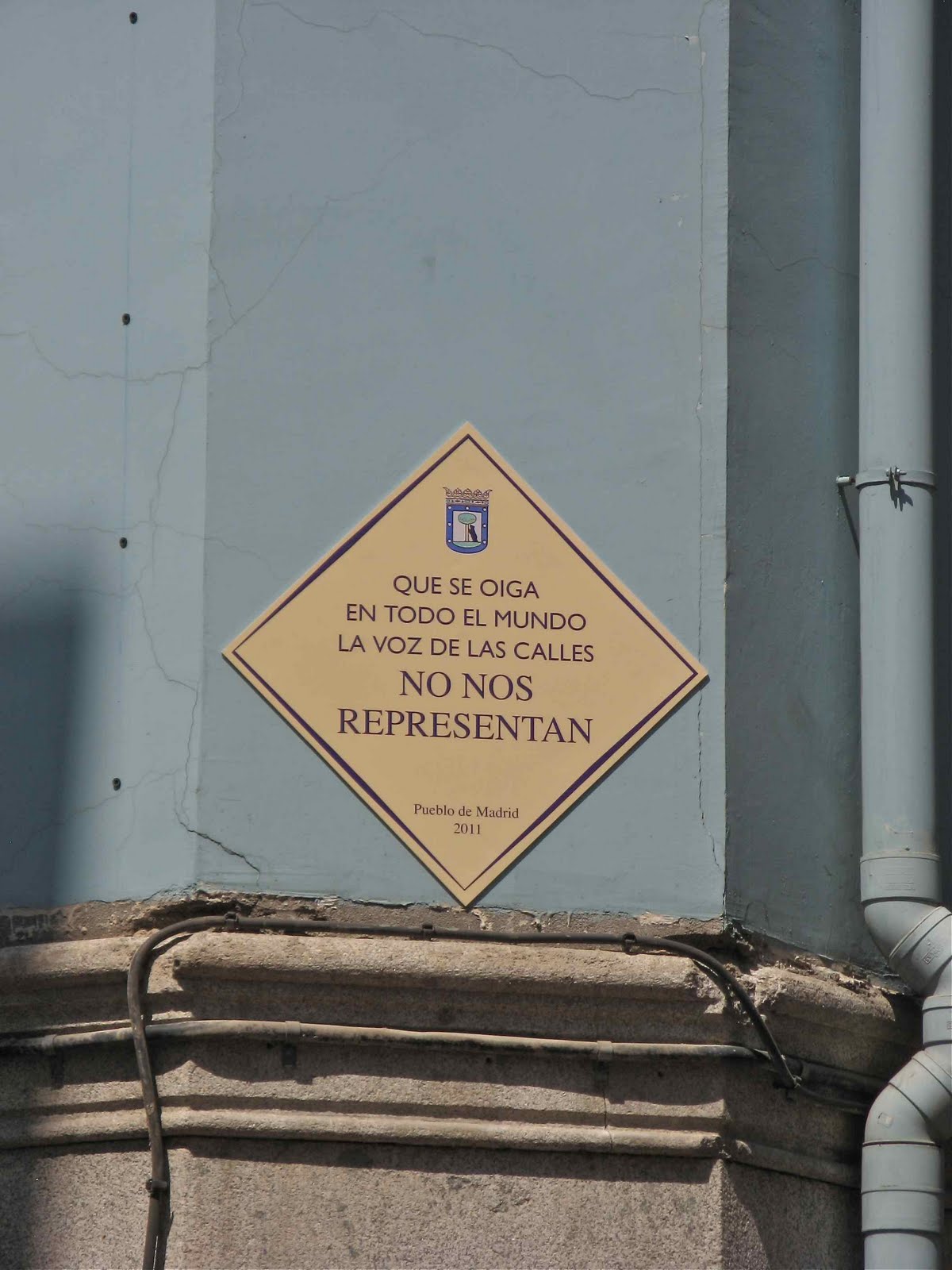
Anyway, enough about the squares. Let's take a walk around the wider, historic, barrio of Malasaña. Several buildings in the barrio display plaques commemorating famous people who have lived there. Including heroines of the 2 de Mayo uprising against Napoleon's troops, or feminist pioneers like Clara Campoamor.
More recently, there have been some new additions on different buildings around Malasaña - celebrating a different kind of uprising. My favourite combines the stencilled face of Aznar on the lamp post with the message on the wall.

Wednesday, August 03, 2011

La Plaza Tomada

It was a pathetic sight last night in Madrid. Circling the (police) wagons in the Puerta del Sol, all entrances to the square blocked by fully equipped riot cops. The police helicopter had been flying low over central Madrid for hours. At one point, over the heads of those in front of me, I caught a glimpse of the barrel of one of those guns the police use to fire gas canisters or rubber bullets. Preparing for a major assault, obviously. But it wasn't going to happen.

"Estas son nuestras armas" (these are our weapons) has become one of the standard chants of those taking part in protests organised by the 15-M movement. Shouted with your empty hands raised in the air. The authorities just don't get it, and the kind of over the top policing that converts many a peaceful protest into a public order problem found itself unable to cope yet again with a movement that refuses to play by the traditional rules. 

Last night, following the clearing of the square yesterday morning, the Puerta del Sol was closed to everyone except the police. Metro trains didn't even stop there. At first the police allowed some to enter the square, based it seems almost entirely on the appearance of the people who wanted to pass. Although well-dressed journalists were not admitted. Again they don't get it. Five "indignados" in a taxi dressed in business clothes were able to pass the barrier the police had put last week around the Spanish parliament. Eventually last night they decided they had to close the square to everyone. 

People came to protest against the eviction that had taken place earlier in the day. The authorities might have calculated that August was a good time to do it, but Madrid is no longer as empty in this holiday month as it used to be. Yet again a miscalculation by those in charge turns out to be a boost for 15-M. The streets around the Puerta del Sol filled with protesters, but the outcome wasn't going to be just a sterile stand-off for hours between demonstrators and riot police. Once again, the old rules didn't apply.

We arrived a bit late, to find crowds of people moving down the Gran Via, but not walking on the pavement. "Where are you all going?" we asked someone. "For a walk" was the reply. Half the Gran Via closed to traffic was much better than none of it. Down in Cibeles, where they are already building the stand for the Pope's visit, there were thousands of people and Real Madrid hadn't won anything. Nobody stopped long there, and soon the whole of the Paseo del Prado was occupied by protestors. The police were still busy recreating Custer's last stand inside the city centre.

Nobody gave any orders, another thing the idiots who govern us fail to understand. Everyone more or less knew where we wanted to go, so the Calle de Atocha ended up closed to traffic too as the ever bigger crowd turned back towards Sol, observed by bemused tourists. "Esto es lo que pasa por echarnos de la plaza" was probably the chant of the night. But Sol is not the only square in Madrid, after stopping for a while at the police line where the man with the gun was probably feeling anxious to test his weapon the protest moved onto the nearby Plaza Mayor to celebrate a mass assembly. Custer's men spent the night in the otherwise deserted square, protecting their wagons. They're still there this morning. Was it worth it?

Tuesday, August 02, 2011

Haven't You Got A Home To Go To?

As I write this post the police helicopters are still clattering over the centre of Madrid. They've been there since early this morning, as part of a huge police operation to remove all traces of the 15-M protest movement from Madrid's Puerta del Sol. All this overkill in reality is just removing the wooden information post that was set up when the camp was dismantled in Sol a few weeks ago. Today's operation follows a failed attempt to do something similar last week which ended with police charges against peaceful protesters in the Paseo del Prado. August, when the city is at its quietest, is no doubt seen as a good time for moving against 15-M after the relatively lighter attitude adopted by the authorities in May and June. After all, the Pope is due to arrive soon.

The Madrid police have been complaining recently about not being able to take on 15-M, following some incidents where protesters have interrupted the identity controls that police operate in selected Metro stations around the city. These controls are aimed against immigrants, as the targets are inevitably those who do not look like locals. Officially they do not exist, as the government has consistently denied that they take place. Photographers and journalists who have challenged this denial of reality have ended up being arrested and having their equipment seized. So we are left with the somewhat surreal situation where the police complain about not being able to carry out a task which their political bosses claim is not carried out anyway. Stopping something which doesn't happen can hardly be a crime?

Another cause of tension between protesters and police has been the campaign to stop people being evicted from their homes for mortgage arrears. Several judicial evictions have been stopped by protesters in recent weeks, leading the authorities to respond by massively increasing the police presence at these events. 120 police were used to evict someone owing a couple of thousand euros in Madrid last week. The cost of this operation? We're not entitled to know. In Barcelona, where the police are allowed to use as much violence as they like, we were treated to the ridiculous sight of the Mossos de Esquadra using ladders to force entry into an apartment and evict a family. Accompanied by the now familiar baton charges that they seem to use against any protest in the city. 

It's become almost commonplace for people to see a busy restaurant in Spain and remark "Crisis, what crisis?". There is a contrasting reality, the annual rate of home repossessions is running at around 90,000. Although the issue of Spain's mortgage legislation has been debated in recent months, the true scale of what is going on has only become apparent since 15-M took to the streets. Spanish mortgages promise a win-win situation for the banks who enticed so many people into huge mortgage commitments and who get to chase these same people for the remaining debt even after they have repossessed the property and in many cases sold it on at a knock-down price. There is no strong incentive for the banks to try and get value for money out of the property if they know they can continue to pursue the mortgage holder.

The government and the opposition Partido Popular have both come out in clear opposition to the idea that those who can't pay their mortgage can hand back the keys to the bank and clear the debt by doing so. Neither party is comfortable with any idea that involves doing something that the banks don't want to contemplate. It's just not enough that we all assume the debts of the banks. Some recent concessions on the amount of a person's salary that the banks can seize as part of the eternal mortgage recovery process were a nod in the direction of 15-M, but the movement will continue to highlight the cases of thousands of people being removed from their homes with no evident alternative and with only a debt to the banks to take with them. The victims of the crisis are no longer hidden from sight, and ever heavier policing is unlikely to solve that problem. 

Sunday, July 10, 2011

The 19J In Madrid

I'm getting further and further behind with my posts on this blog, a mixture of other commitments, summer laziness, disastrous time management and an occasional inability to write all come together to create this situation. So here is a much delayed post on the 19th June demonstration in Madrid, the last major mobilisation from the 15-M movement.

The march was divided into several geographical "columns" which converged as they got closer to the finishing point, the Neptuno fountain just down the road from the Spanish parliament. I joined the group leaving from the Plaza del Dos de Mayo, which made its way through the streets of Malasaña until it met with another group coming from Chueca close to the Metro station of Tribunal.


This was a meeting of the barrios, the district level groups that have now taken up much of the campaign work since the protest camp in the Puerta del Sol was dismantled. The enlarged group then made it's way up to the Glorieta de Bilbao to meet the sizeable contingent coming down from the barrio of Chamberí.

The preceding week had seen a torrent of propaganda from the right-wing press about how violent the 15-M movement was following some not really very violent at all incidents outside the Catalan parliament. It's worth pointing out that there wasn't even a single police officer in sight until the march united with the Chamberí contingent. Then they put a car and officer in front to control traffic as the larger and noisier demonstration made its way down to the Plaza de Colon. On the way we had to pass the national headquarters of the Partido Popular where a single van of the national police was stationed to deal with the supposedly wild anti-system hordes.


The success of the idea of dividing the protest into columns became apparent in Colon. The part of the march I was on stopped and many took the chance for a welcome chance to sit down on a very hot Saturday afternoon. I wandered across the square to the bottom of the Castellana to see the Northern Madrid column of the 19J just about to arrive. The atmosphere as this column united with the Malasaña-Chueca-Chamberí section was tremendous, and what was by now a march of many thousands set off down Recoletos and the Paseo del Prado.


Arriving in Neptuno there were already people present, although the columns from the south of the city had yet to arrive. Unlike the set-piece protests beloved of the PP and their front organisations, this was a march that started in one place and ended in another; one of the columns from the south covered around 13 kilometres. Many of those in Neptuno took refuge from the sun underneath the huge trees that the combined forces of Aguirre and Gallardón have not yet succeeded in chopping down.

Where there was a serious police presence was in front of the Congreso, Spain's parliament. The access was blocked but in any case a huge banner reading "Respeto" had been strung across this point and a sort of no-mans land had been defined between demonstrators and police. The hopes of Intereconomía and other ultra media groups were dashed as the atmosphere in the demonstration continued to be festive. There was even an orchestra playing. The columns from the south arrived to a fine welcome from those who were already there, and it was clear from the numbers attending that the movement had not lost any of its momentum from that march on the 15th May that finally nailed the idea that Spaniards were not interested in protesting about their situation. Other cities around Spain also saw large protests.


The 15-M movement isn't stopping for the summer, there is still a lot of activity going on in Madrid's barrios and marches of "indignados" have set off from different points around the country, converging on Madrid on the 23rd July. The campaign against evictions for mortgage arrears has forced the issue of home repossessions onto the national political agenda, and the Madrid police are no longer finding it so easy to stop people in some Metro stations based on the colour of their skin. Meanwhile a difficult debate is taking place in Madrid over the way to coordinate the initiatives taking shape in the barrios without compromising the democratic principles of the movement as the focal point of Sol has moved more into the background. The movement mutates and adapts in unpredictable ways, a reflection of that horizontal structure.

Tuesday, June 21, 2011

Breaking Camp In The Puerta Del Sol

Arriving far later than originally intended, a photographic summary of the dismantling of the protest camp in Madrid's Puerta del Sol. The decision to leave the camp on Sunday 12th June was taken after a long assembly the previous week. Long because every attempt was made to accommodate the opinion of the minority who were against leaving the square. Eventually a consensus was reached which consisted of those who wanted to remain having to make proposals acceptable to all if they wanted to stay in the name of the 15-M movement. That didn't happen, and on a hot Sunday morning the work began to clear the camp.

Huge amounts of material were removed from what had become quite solid structures during the lifetime of the camp, as well as the hard task of removing traces of posters and stickers from the Metro entrances and other structures in the square. The people from the camp took the task of clearing up very seriously and the municipal cleaning services provided the containers and lorries to move the debris away.


Not everything was removed from Sol, and there was even a bit of new construction. The movement had decided to leave an information booth about the campaign in the square, and here it is in construction.

Alongside the information booth there were a series of other reminders of what had been here since the middle of May.


The vegetable garden was still there in Sol when I passed by on Sunday following the big demonstration in Madrid. Doing surprisingly well considering the hostile environment in which it has to survive.


After the dismantling of the camp there was still time for an assembly to mark the occasion and to make clear that the campaign that took off on the 15th May is far from over. 

This is the information booth in the square once it was up and running.

Some of those who opposed leaving the camp claimed that the extension of the campaign to the barrios of Madrid wasn't yet ready. In reality, it had been running well already for a couple of weeks and the proof of that was there to see in the successful protest held on June 20th, as well as in the huge range of activities that are now being organised at local level around the city.