Sales forecasts for what the Spanish are not allowed to call champagne are looking fairly good for this Christmas. Not much news in that normally, cava is a standard feature of the Spanish festive season, and the producers spend huge amounts of money on their pre-Christmas/New Year advertising campaign. However, last year sales dipped a few percentage points as all the angry right thinking people in Spain protested about the Catalan autonomy statute by boycotting products from the region. I did my best to offset the effects of this stupid campaign by buying a couple of extra bottles, but I didn’t spend much time in Madrid last Christmas. Anyway, it seems that the outrage has died down now that the statute has been approved and Spain still appears to be more or less in one piece.

They said I was mat! I'll show them....
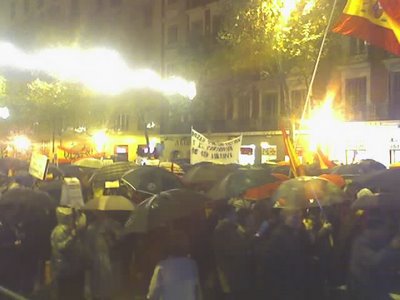
Crazies night out....
Aznar stands firm..he's in there somewhere....
See how difficult it was to get close?
The Saints - Lipstick On Your Collar
Despite her troubles, she keeps smiling....


The Fundación Franco have also announced a mass in Franco’s memory for this Saturday at the Valley of the Fallen near to Madrid – the weather forecast is for rain.
Via escolar.net
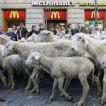
The spectacle attracted huge crowds, now that not so many Madrileños have such close connections with the villages where their parents came from. It also reportedly collapsed traffic in the city, although recently I’ve come to the conclusion that it is pedestrians that are at the heart of Madrid’s traffic problems. The reason I have reached such a startling conclusion has been the activities of the agentes de movilidad (mobility agents), a uniformed force created supposedly to improve traffic flow in the city. How do they do this? From my experience their main activity is to reduce the amount of time that pedestrians have to cross the road; hence my conclusion that those who choose to walk are clearly the main obstacle to free flowing traffic. It’s not as if Madrid drivers need much encouragement to indulge in the ancient tradition of “saltando el semáforo” (jumping the lights), I’ve had people almost driving over my feet as they accelerate in the face of a traffic light that has just changed to red.
So there you go, if we could only get rid of the sheep and the pedestrians, the traffic problem goes away. Forget all that nonsense about it it having something to do with the number of cars on the road.

Meanwhile, the bizarre case of the "boric acid report" supposedly linking ETA to the Madrid bombings is moving towards an ever more absurd conclusion. The Madrid judge Gemma Gallego has overturned all of the conclusions in the case that were reached by fellow judge Baltasar Garzón, who accused the original authors of the report of committing an act of falsification of official documents. Gallego has cleared the three police officers who prepared the original report, explaining their curious decision to reissue their report 16 months after the original was rejected by saying that they had noticed the original was no longer in its envelope. We are offered no further explanation of their actions and no mention is made of the fact that all copies of the report almost immediately made it into the hands of El Mundo following this decision to reissue.
On top of this, Gallego has prepared the way for almost the entire chain of command of these officers to be prosecuted for the offence of falsification; no fewer than four senior officers are facing the possibility of being charged. All of this because an entirely speculative paragraph relating the discovery of boric acid, a common household substance, in the home of one of those accused for the Madrid bombings to the same substance being found in the safe house in of an ETA commando, was removed from the final version of the report. There is no connection between the two discoveries, there is no suggestion that boric acid was used in either case for anything relating to terrorist activities, and there is no record of boric acid ever having been used in such activities in Spain. The decision to delete the reference to ETA in what is supposed to be a report based on scientific analysis is entirely justified.
Perhaps Gallego has strong legal reasons for the conclusions she has reached, but her handling of the case has been far less transparent or comprehensive than that carried out by Garzón, who explained his reasons in detail. El Mundo is already running with the issue as if those accused have been convicted, should that actually happen the conspiracy theorists can be expected to go into overdrive with their allegations that connections between ETA and the bombings have been suppressed as a result of political pressure from the government. Wait a minute, did I forget to mention something? Oh yes, judge Gallego is a candidate of the conservative judges association for election to the Consejo Superior del Poder Judicial. This body is supposed to play an important part in the running of the judicial system, but it has recently become discredited because the current conservative majority has acted as a partisan bloc adopting decisions with evident political intentions. Given the behaviour of the current Consejo, it is unlikely anyone is nominated for the conservative association without being a loyal follower of the party line; Gallego should feel at home if she is chosen.
I have no idea whether the courts in Madrid have a statue of the Scales of Justice, but if they do I suggest the best thing to do would be to place it in a dark corner and cover it with a sack, because justice has recently become a rare and precious commodity in these parts.

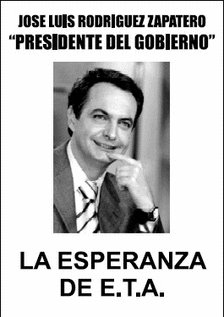
The main enemy - for the AVT

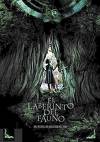
One night, close to the mill, Ofelia discovers a ruined labyrinth and inside this labyrinth she encounters a faun (played by Doug Jones), who reveals to her that she is really a princess whose return to her magical kingdom is eagerly awaited. To return to the world from which she came, she must pass three tests before the full moon. The story of how Ofelia tackles these tests provides the structure for the fantasy part of the film, and the most imaginative scenes of the film.
Meanwhile back in the real world, the mill is run by the servant Mercedes (Maribel Verdú), apparently loyal in following the orders of Vidal; whilst secretly doing everything that she can to help the rebels. The local doctor (played by Alex Angulo) also plays a dual role, taking care of Ofelia's mother and at the same time making a risky trip into the mountains to tend injured guerrilla fighters
What might otherwise have been a satisfactory, if slightly predictable, story about the continuing anti-Franco struggle after the Civil War, becomes a different film altogether with the imaginative interweaving of fantasy and oppressive reality. Somehow, del Toro manages to ensure that the two stories in the film are not separate from each other, they interconnect with each other at different points throughout the film. Bizarre though it might seem, the resulting film is strangely effective. This film did not really attract my attention when it first came out, but having seen it I have no hesitation at all in recommending it.