Showing posts with label Economy. Show all posts

Friday, January 10, 2014

The Spanish Austerity Disaster

Spain is in a dire economic situation. If you look at the economic data and especially at the unemployment figures you would think such a conclusion is beyond doubt. All of which makes it so strange to read frequent media reports, from inside and outside the country, which present a radically different picture. These reports talk of a country which has turned the corner and faces a bright future following a difficult period of implementing much needed structural reforms. It's bullshit. Bullshit based on highly selective cherry picking of data and misrepresenting the history of the crisis.  

A few weeks ago, with the publication of Zapatero's book, we finally got to see the content of the letter that was sent by the European Central Bank to ZP back in 2011 when the spectre of the dreaded 'rescue' seemed like a daily prospect. In that strange sort of proprietary attitude that Spain's prime ministers have towards government documents (see Aznar and the documentation about the Madrid bombings), Zapatero seems to have treated the letter as personal correspondence and taken it with him. What is striking about the letter is how little most of the demands contained within it had to do with addressing the immediate economic distress of the country. Instead, it amounts to a (hidden from public view) set of measures that more or less accurately represent the agenda of those who have championed the austerity approach that has now been implemented in Spain.

With the bond markets apparently so content, the stock market rising and the Spanish government busily (desperately?) trying to push an optimistic feelgood factor it seems like a good time to take a look at the results of the experiment. The bullshit really starts with the Rajoy government's bombastic claims about how they have taken the difficult measures necessary to avert the rescue. The extraordinary result of Rajoy's wise and determined leadership, if you have the tunnel vision necessary to believe in it, is that he hasn't just saved Spain from collapse but all the other countries affected by the Euro crisis too! Now there are some who would say that it was Mario Draghi's game ending we'll do what it takes to save the Euro statement that changed things, but that risks undermining the pro-austerity argument. We'll let the data do that.

It's worth remembering that Spain back in 2011 was also at the point of exiting recession. The second recession of the crisis, which covers the last two years, was deliberately provoked by the adoption of those austerity measures that some would now like to credit with bringing about the exit from that same recession. Not just the recession, but the addition of close to another million people to Spain's already enormous unemployment total together with the destruction of productive economic activity that this represents. Companies which had weathered the storm of the first recession without realising (why would they?) that the country would then be pushed into a second one couldn't last any more and closed their doors. It's a terrible price to pay, even more so when you look at the meagre results.

All these measures have been adopted in the name of reducing Spain's budget deficit, the dogma insisting that huge cuts in public spending had to be implemented and ignoring all warnings of the consequences. Assuming Spain has hit its deficit target for 2013, and leaving to one side our generous assistance to the banking sector that counts as deficit, the country has managed a reduction of something under 3%. Not bad is it, 350-400000 jobs lost for each point of deficit reduction? Some might say it hasn't been worth it. Indeed, those insisting on recession as the route to deficit reduction eventually had to recognise it wasn't working, not openly of course but the relaxation of deficit targets was nothing less than an admission that it wasn't working and what ultimately prevented Spain from tipping into the catastrophic state that Greece finds itself in. Nevertheless, Spain's public debt burden is now massively higher than it was before the medicine was administered.

None of this matters to the spinners and the cherry pickers. Look at the exports, they say. The balance of payments is positive, proof that the medicine works. I admire the shallowness of this argument, people who write about economics as a profession but don't apparently understand that throwing hundreds of thousands of people out of work depresses consumer demand and reduces imports. Hey, make another million unemployed and it will get even better! If economic depression reduces petrol consumption to the level of the 1990's then marvel at the success for Spain's import bill! On the export side it is of course completely true that Spain's exports have been the success story of the crisis, the only success story to be told apart from the ability of the financial sector to suck us dry. The problem comes when the spinners try to attribute this success either to austerity or to the accompanying 'reforms'. The improvement in Spain's exports predates all of the austerity measures adopted, and the much vaunted labour market changes. We have to give credit though to austerity for finally putting an end to that export improvement, squeezing the economy of the entire Eurozone means that Spain's major export markets aren't in the mood for buying either. 

It's odd, because according to the destructive dogma Spain couldn't possibly be a successful exporter in the last few years. We've been told all along that the fundamental problem for Spain is that it has become uncompetitive, and the austerity programme has been a clumsy attempt to force through the internal devaluation (read reduced wages) that would restore the economic balance with its competitors. Ironic then that it should end up damaging the sector of the economy that dared to contradict the sacred theory. This disastrous strategy of destroying broad sectors of the economy in the belief that a dynamic new model will magically emerge from the wreckage hasn't worked anywhere it has been tried. The destruction of so many low productivity unskilled jobs doesn't mean they get replaced by better ones. Just look at the few new jobs being created. 

This is where we get to the grim reality. Spain's economy has changed as a result of the crisis but it has gone backwards rather than forwards. For all the talk of reforms, and it is mostly talk, the objective of Rajoy and company has been to weather the storm with as little fundamental change as possible. I laugh when I read articles in the press about the wide ranging reforms Spain is supposed to have undertaken, wondering about the use of the plural. If you disagree try to make a list of them without thinking too hard and see what number you get to. The main change is in the labour market and because people don't buy those nasty imports if they have no money we should of course be pleased that the move towards more precarious low-paid employment is showing signs of success. Just as we should be pleased that many of the better educated young people are leaving the country. The government is certainly pleased with this, it's one way of reducing the unemployment total short of a serious epidemic. PP supporters gleefully proclaim the benefits of a period abroad. Character building.

This is not to say that Spain hasn't touched bottom on job destruction, just that reaching that point still leaves it far away from anything resembling sustained job creation. The labour market now requires detailed attention to see what is really happening. It is clear from the difference between social security figures and drops in the unemployment total that many people have simply dropped out of the labour force for one reason or another. It's also clear that many of the (overwhelmingly temporary) jobs created in 2013 were due to an unexpectedly good tourism season. Emigration, seasonal work in tourism and agriculture. Remind you of anything? Yes! A bonus point to the person at the back who said the 1960's. We've done the 1930's revival in terms of economic 'theory', so its time to move forward through the rest of the last century. Shame the construction leg has been blown off, let's hobble forward on tourism, good harvests and the distant hope of ridiculously oversold pelotazos like the Olympics and Eurovegas just to show how things have changed. 

Things get grimmer. Any Spanish emigrant who finds a good job overseas should hold onto it for at least 10 years and just enjoy the holidays back in the old country. No serious prediction can be found showing promising economic growth for Spain in the next decade. Next year the official prediction is currently (these things change almost monthly) for 0.7% growth. It doesn't get much better for the following years and the 2% growth that might indicate conditions for making a serious dent in that unemployment total looks far away. 2020 is the year I see quoted commonly for Spain's GDP to reach pre-crisis levels, but don't even imagine pre-crisis employment levels for that date. 12 years of crisis is some, cough, business cycle. Stagnation is the outcome for the next few years, sluggish growth at best. If you think or hope otherwise then ask yourself about the attention paid to pensions. Spain's public pensions are sustainable with high employment, so why so much attention focused on reducing their value (apart from the obvious commercial interests of the contracted experts)?

The markets and the banking sector seem very happy with this prospect, who wouldn't be after the vast sums of public money pushed their way. Hedge funds picking over the few bits of flesh left from the construction boom are presented as if they were investments in the future of the country. The electricity companies can raise energy bills 10% a year and still have the government claim that we owe those same companies ever greater sums of money. Seats on the board await the valiant ministers who indulge them. That thick layer of 'comisionistas' - notaries, registrars and other 18th century leftovers who are extremely well represented in the government not only remains intact but will be given extra sources of income for hitting a piece of paper with a stamp. No need to wonder why Spain has such low salaries for a high cost of living. A brutally unfair tax system remains fundamentally untouched, rewarding fraudsters and the wealthy whilst those with low to medium incomes bear the brunt of the tax burden.

Managing expectations and declining living standards for the majority of the population is the challenge. Spain's government has it hard in this respect, they have a spectacularly greedy and corrupt elite and little chance for the next few years of keeping the masses content with an asset bubble like the last one. I remember those on the right who used the ridiculous taunt that the left just wanted to redistribute wealth instead of creating it. How things have come full circle, this is effectively now how many European governments are working with the tiny detail that redistribution goes from the poorest sectors to the wealthy. There's no money to pay for anything you see, unless you represent part of that elite. Nobody travels down the toll roads built by your company, we'll sort that out with compensation which we can add to the deficit. You have this expensive and useless arms contract to pay for? We'll just slip a special provision into the budget to pay for that. You need a new hospital! Didn't you hear us when we said there's no money!

Spain never had a significant welfare safety net, but austerity has bitten a big chunk in what existed. Payments to dependent people, so they can be properly looked after, have been almost killed off. The PP always hated a measure that did so much to help some of the most vulnerable who should be shivering in the cold outside churches anyway. Pensions are declining, their real value undermined in a typically underhand manner, just at a time when unemployment means many households are dependent on the income of their retired members. Hundreds of thousands of people have been left without any guarantee of health care, with all the consequences for public health that this entails. Who knows how many habitable homes are kept empty whilst families lose their home because of mortgage evictions. Anything linking incomes to prices is being removed, a link never needed by those who can award themselves huge bonuses for each successive year of failure.

The pro-austerity party have got everything they asked for, although you sense it will never be quite enough. There will always be something lacking that stands in the way of the coming Spanish economic miracle. That final labour market change perhaps, although I did see a job advert on Twitter yesterday that advised anyone expecting payment not to apply. The gloomy economic predictions don't come from the anti-austerity side, they are produced by the same organisations and companies that championed the austerity process. Even their own economists don't believe the propaganda when it comes down to it. What began as a private financial crisis is still a private financial crisis and the critics of austerity have been been right about everything they said would happen. The real austerity disaster is that the people who got it wrong are still in charge. Determined to learn no fundamental lessons from the failures that caused the longest economic crisis since the 1930's, the only route they offer leads towards the next one.

Thursday, April 25, 2013

Unemployment In Spain....Carry On Regardless


Another hilarious sequel with all your favourite characters. Mariano, as usual, has nothing to say. Laugh, we wish we could!

Monday, April 22, 2013

Voting With Their Feet

Puerto Natales, one of the places where we stayed on our trip to Chile last winter, is not a big town. In the Patagonian summer it does modestly well out of tourism, mainly from those who want to walk, as we did, the nearby Torres del Paine national park. Given the way the wind blew when we visited I can't imagine wanting to spend too much time there outside of that slightly warmer season. It's certainly not the first place you would expect to find members of the growing Spanish diaspora, those for whom economic exile is becoming the only way forward. But the waiter who served us one night in the local asador was from Barcelona, and the receptionist in our hotel from Canarias.

Then, a couple of weeks ago, we were at a family wedding in Oxfordshire. Having breakfast in the hotel the morning of the wedding my partner was talking in English to the waitress for a few seconds until, in that way the Spanish have of recognising each other, the waitress started talking to her in Spanish. Two people from Cadiz working in the middle of the English countryside. Last week it was a weekend in Innsbruck, the hotel receptionist who checked us in was Catalan. So what, some people say, young Spaniards have spent periods abroad for years and there is some truth in that. London in the late 1980's and 1990's always seemed to have a large Spanish population.

But I think some things have changed. Young Spaniards are not just going overseas now to get away from home for a year and pretend to learn a foreign language. Also, many of those who are leaving are not so young. People who would possibly be thinking more in terms of a settled life and maybe starting a family are also amongst those looking for a fresh chance overseas. This is not the rural exodus of the 1950's and 1960's, many of those making the move belong to the best educated sector of Spanish society. Many of them are going for the foreseeable future.

To the lords of the rentier economy, the Botins and others, there is no problem. They've got what they want from the crisis and everything seems to be going just fine as they pick over the debris from the crash. A complacent, and utterly useless, government seeks only to manage the situation in such a way that they don't get replaced by anyone else. Job creation is a skill reserved for friends and family only. The Spanish government even sets up websites to encourage people to look for work overseas. This weeks new government euphemism in a crisis where euphemism production has never been so healthy is to describe the growing exodus as "external mobility". 

The government will be happy to get rid of those voters most likely to be critical, and emigration looks like being the only factor in the next few years (barring extensive statistical manipulation) that can make any significant dent in an unemployment figure likely to reach 27% by the end of this year. So if lots of people leave it can be presented as yet another fake signal of economic recovery. Those on the receiving end are not fooled by the talk of recovery, they can look at piles of unsuccessful job applications, their friends in the same situation, and draw a sad but understandable conclusion. It's Spain's huge loss, a well prepared generation taking their skills elsewhere.

Wednesday, December 19, 2012

Spanish Rescue....Rajoy Speaks Out

It's a South of Watford world exclusive. Spanish Prime Minister and well known man of action Mariano Rajoy spoke to this blog with unprecedented frankness on the possibility of his government asking for an EU financial rescue package. This is what he had to say:

"If we choose to ask for what you like to call a 'rescue' then we might do it; or not. On the other hand you could tell me what we might be doing. Today we are not asking, tomorrow we might. Or not. We've taken a difficult decision not to ask for it until we do. But first we need to know whether we will be asking for it or not. If we feel the need not to ask for the rescue then we must first establish what we are not asking for. Is berry difficul todo esto."

Questions?

Wednesday, December 05, 2012

Happy Anniversary

With all the fuss around the Catalan elections, the first anniversary of Mariano Rajoy's election slipped by almost unnoticed. Of course it's still not a year since he (allegedly) took office as it takes a month or so after the elections for a change of government to take effect in Spain. Anyway what a year we've had, packed with hugely impressive achievements of all sorts. This is really just a small sample:

Unemployment - at the end of the third quarter of 2011 Spanish unemployment stood at a measly 4,978,300. Thanks to the rapid and forthright measures taken by Rajoy's government to reactivate the Spanish labour market, we have now reached the historic high of 5,778,100. The once remote possibility of having 6 million unemployed in Spain will now almost certainly be happening in 2013. If that perhaps seems a bit grim, it's not all bad news. Hundreds, if not thousands, of new jobs have been created in the public sector for friends and relatives of senior PP politicians. 

Economic growth - if last year the economy was showing some weak signs of recovery (Spain was no longer in recession) the new government swiftly put paid to any of those old fashioned notions about the necessity of economic growth and now we have -1.6 growth and a profound recession which is predicted to last throughout next year at the very least. 

Taxes - the party which took to the streets against an increase in sales tax when it was imposed by Zapatero quietly deleted the web page publicising this campaign shortly before Rajoy introduced a further increase in the same tax. Income tax has also been increased but then the requirements of having a balanced view oblige me to put the other side. The onerous burden of shared sacrifice means that the enormous fortunes stashed away in the SICAV investment funds have retained their hugely generous tax status untouched. A similarly generous tax amnesty for fraudsters has flushed out less than half of the target figure even on the government's own figures.

The banks - in one year we have gone from "we won't put a euro of public money into the banks" to the Bankia fiasco and possible fraud and the creation of a bad bank. Worse, that is, than the others. 

Still, at least the pensioners have been protected? The last remaining unbroken electoral commitment of the few that Rajoy actually made has just fallen, with the breaking of the link between pensions and inflation. Rajoy had made a sort of implicit contract with pensioners, they would vote for him to protect their pensions whilst he made sure that future generations would never enjoy the same conditions. He lied.

Yes, it's been quite a year.

Saturday, October 27, 2012

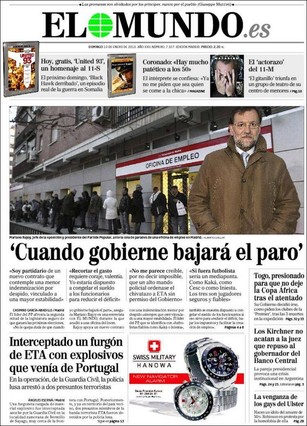
Cuando Gobierne Bajará El Paro


5778100 and still rising. 1737900 households where nobody is working. Unemployment in Spain is above 25% for the first time ever and it would be churlish not to acknowledge the key role played by that important labour market reform we got earlier this year. Still, with temporary contracts only taking around 90% of those few new jobs being created, there's clearly still everything to play for.

Wednesday, May 30, 2012

Bullshit And Bulerías In Bankia


It's now over 3 weeks since I last blogged on the subject, but the crisis over the bailout of Bankia rages on. As each week passes we learn more about the colossal disaster that the bank has become. The amount needed to save Bankia seems to rise almost every day and the disastrous handling of the issue by the government came dangerously close to provoking a run on deposits in the bank.

More than just being another episode in an ongoing financial crisis, the Bankia situation does show every indication of being a full blown scandal. How is it that a bank which announced profits of millions of euros and which was still talking of making new acquisitions just a couple of months ago has been revealed to be a wreck with such enormous losses? 

The government is doing everything it can to avoid any kind of investigation into what has happened, criminal or otherwise, and is getting some help from the PSOE. The PP have tried hard to put all the blame on the outgoing governor of the Banco de España, who does deserve his share of criticism. But then we are still left wondering what exactly Rodrigo Rato and friends were doing in return for the millions they took out from presiding over the bank?

As usual in these situations it's the little people who take the hardest hit. Given the lack of interest from the big investors, Bankia mobilised its whole commercial network to sell shares to its own customers. I know personally of one case where €3000 was simply deducted from an account without consent in return for what would now be a virtually worthless shareholding. The 'mistake' was of course corrected, but I wonder how many other cases there were.

The PP have blocked the possibility of parliamentary investigation, even though they could easily use their parliamentary majority to convert any investigation into a circus. What should be happening is a full criminal investigation to examine what really happened inside the bank. Best wait for that sitting down, as the Spanish like to say.

It says an awful lot about the way this government operates that the announcement of how much public money Bankia needs was made by the newly appointed president of the bank, with a figure way above anything which had been suggested by government ministers. Then there is the (deliberate?) confusion over the way in which the bank will be rescued. True to their ideology, the government is making it fairly clear that there will be no general public benefit in return for €19,000 million of help.

The only response to criticism of their handling of the crisis has been attempts to distract public attention. Anything will do, the spat with Gibraltar, the chorus of whistles that greeted the national anthem at the Spanish cup final. All with the help of servile newspapers who find day after day that Bankia is not a significant enough issue to make the front page.

Spain's government is being crushed by the weight of its own mediocrity and inability to respond to the situation. After Mariano Rajoy's surprise press conference the other day, there are now not so many criticisms of his refusal to explain events. Because it has become evident that he doesn't have an explanation to offer, merely a collection of recycled cliches. The problem with this government is that they have the capacity to make the outcome of the crisis even worse for Spain because of their determination to politically manipulate the situation the country faces.

Some will be happy at the suggestions that the EU is now demanding even more cuts in return for possibly relaxing a budget target that nobody seriously believes to be achievable in the first place. However, the argument that this is a crisis of public debt looks more and more frail every day. It's about public resources being used to prop up the private sector. There are some absentees from the list of those accused of mismanaging the banking crisis, because those who control Spain's biggest banks have been instrumental in driving the disastrous strategy. Happily, not everybody is taking this situation lying down.


Tuesday, May 08, 2012

Rato Leaves A Sinking Ship

The news yesterday that Bankia is going to be bailed out by the Spanish government has put the stability of the Spanish banking system back at the centre of the country's ongoing crisis. In the process the government has managed to simultaneously create a certain degree of nervousness about the safety of deposits with Bankia as well as significant outrage over the proposed bailout - which could involve as much as €7000-10000 million of public funding. We don't yet know how a government which previously claimed it would use no public money to bail out the banks is going to manage the turnaround, Friday is the bad news day. The commitment on no public bailouts is now just another of those broken promises which sees virtually nothing remaining of the few concrete commitments that Mariano Rajoy made prior to the elections.

The surprising part of the announcement was that it came coupled with the removal of Rodrigo Rato as Bankia's president. Rato, at least until yesterday, was regarded by Partido Popular supporters as an economic wizard; based on him having been economy minister at the start of Spain's economic bubble. More recently he has just cashed in nicely on running the bank which holds a huge amount of devalued construction related assets and bad loans. Thanks of course to Rajoy's decision to place him as boss of Caja Madrid, Bankia's main component. Which makes it even more significant that such a powerful figure in the PP should be removed by a government of the same party. Because he was removed, it seems. The situation is made even more ironic by the fact that the move against Rato was spurred by a critical report from the IMF, Rato having been director general of that body until he walked away from that job before the shit hit the fan.

The whole Bankia situation stinks, and exposes in the process some of the false narratives that are used to justify the less well off sectors of Spanish society paying the brunt of the economic crisis. We were told that the fusion of the regional savings banks (the cajas) and their conversion into banks was a necessary step to clean up the mess left by the end of the construction boom. The cajas were bad because they are not run by professionals, was the story. Some story, because Bankia is now a bank resulting from this fusion process and all that has been created is an even bigger and more expensive monster. By the way, if things get really bad then don't expect the fund supposedly guaranteeing deposits to help account holders. That money has already been systematically ransacked to pay for a series of pointless fusions. 

What makes things worse is that Bankia has already received significant public funding, in addition to what would turn out to be very expensive state guarantees if the bank were to go under. Funny, isn't it, that when we are told no money is available for public services the situation changes so quickly when it's the financial sector that comes calling? Especially when we were repeatedly assured that the problems were being solved. Don't go asking about the regulatory role of the central bank. Spain's Banco de España has been largely absent as banks and cajas have struggled to survive. Largely because the governor of this institution, Spain's highest paid funcionario Miguel Ángel Fernández Ordóñez, has been far too busy in recent years lecturing ordinary Spaniards on how well they have been living and why they need a good labour market reform to sort that problem out. 

But at least we don't need to feel too sorry for Rato, he usually manages to land on his feet. It seems fairly likely that the economic terms of his departure will not be those set in the latest labour market reform for getting rid of employees.  It was his economic model that failed and led the country into this crisis, the structure of the banks makes little difference to the outcome when the dependency of the whole sector has been on building ever greater numbers of houses year after year based on the assumption of endless credit. Bankia is still stuffed full of PP appointees and the solution adopted to allow them to continue in their comfortable positions is unlikely to be favourable to public finances. In this situation it is Rato that has been left, perhaps to Rajoy's satisfaction, looking like a greedy banker.

Tuesday, April 10, 2012

Simiocracia

Mariano Rajoy, the man who proudly proclaimed in January that he would always show his face and never hide from the crisis, left today's Spanish senate session by the back door to avoid having to answer any questions from journalists. This on a day when Spain has again been battered by the markets, to an extent that has previously provoked the dreaded EU "rescue" for other countries. All of which comes the day after an increasingly panicky government tried to placate the markets by throwing them a bone in the form of €10,000 million worth of additional cuts in Spain's health and education services. Because, as we all know, health and education services cause tremendous problems for a modern, 21st century, economy. Just as they did in the 19th century. These are services which have gone, in the space of just 3 months, from being "untouchable" to being top priority for cutting. The PP made very few concrete commitments, but they have already broken almost all of them.

Rajoy seems to have very quickly achieved the difficult task of making Zapatero look like a far sighted, long-term strategist by comparison. Those who so freely accused Zapatero of constantly improvising are now all over the place, although they maintain their ideological focus. Hence the offer of cuts in education and health in response to all the attention focused on the financial sector and its dodgy finances. The latest cuts figure was announced yesterday buried in the third paragraph of a press release, and with no indication of any sort of where the cuts are to be made. It's had no effect of any kind when it comes to improving Spain's situation, nor was it ever likely to. But now the government has created a situation where the cuts will have to happen, or they will be punished for not doing them.

This seems like a suitable time to recall how little Spain's public services have to do with the crisis here, which is above all a problem of construction related private debt. From the creator of the admirable Españistan we now get Simiocracia.


via Graham Hunt

Wednesday, April 04, 2012

A Budget Which Will Change Nothing

One of the comfort blanket beliefs of Partido Popular supporters as they finally start to come to terms with the true nature of Spain's crisis has been that their government is doing things properly and that the reward for this has been a decline in market pressures on Spanish bonds. Well they've just lost their blanket. Today's not very successful bond auction shows that once again it's the turn of Spain to be pushed a bit further along the path which the Irish, Portuguese and Greeks have already taken. The recent lull in such pressure has had everything to do with the "barra libre" policy adopted by the European Central Bank in terms of giving huge sums of money to the banks whilst of course doing nothing to help the countries most affected by the debt crisis.

But surely the Spanish government is doing everything asked of it, supposedly what the markets want? Leaving aside the almost incidental 0.5% difference between the deficit target the Spanish government wanted, and the one they have been given by the European Union. The much vaunted labour market reform, which is already helping Spain progress towards 6 million unemployed, and now a budget which aims to slash 3.2% off the deficit in a single year. It is always either too little or too much. Usually the former, but once it becomes clear that Spain's chances of economic recovery are being fatally crippled by these measures then the excuse for making it ever harder for the country to finance its debt will become the poor prospects for economic growth. It's this wonderful Catch-22 that allows the roulette wheel to keep on spinning. 

So the idea that slashing public spending to cut the deficit is going to let Spain escape is lacking any credibility. Even less credibility can be given to the arguments from the government that this lays the basis for economic recovery. Apart from this, it's extremely unlikely that the government will get anywhere near the deficit target this year. I haven't seen one serious analysis of Spain's situation which suggests it is possible for the government to achieve such a big reduction of the deficit in the midst of a recession. The government doesn't believe it, hence their strenuous efforts to change the target for this year. The combination of spending cuts and tax increases announced in the budget is the minimum amount (a mere €32,000 million) needed to get to the target, but the downward spiral that these cuts set off is more likely to increase the deficit than reduce it. 

The IMF estimate of a 1.7% GDP decline for the Spanish economy this year is already outdated. Revisions of these estimates are almost monthly events these days. With the latest measures announced in a budget that was delayed for electoral reasons, it is reasonable to start thinking in terms of a 2.5-3% decline for 2012. If, as may well happen quite soon, the response to the failure of the first package is more of the same then it becomes distinctly possible for this provoked recession to match that which we already saw in 2009. Even some of those who blindly followed the dogma and assumed this madness was bound to work are now revising their positions when faced by the bleeding obvious. Not that they acknowledge the shift.  All this pain to achieve nothing but further destruction of productive capacity can in the end only be justified with a narrative that distorts reality beyond all recognition. 

Much of the damage to be caused by the cuts is still to be revealed, almost half of the cutbacks have to be made by the regional governments who are the authorities responsible for education and health services. The way the government has presented the new budget makes it all seem relatively painless, but hidden in the details are measures which can only make life harder for many. Despite the talk of a general percentage cut across ministries, some of these are doing much worse than others. International aid has been brutally slashed, public works investment takes a huge hit and the money spent on scientific research is also heavily cut. Out the window goes the budget dedicated to assisting job seekers, and that which assisted young people in finding somewhere to live. We wouldn't want anyone to start thinking that Rajoy's government has an economic model in mind that isn't based on cheap labour, concrete and tourism. 

The government claimed that it has no intention of cutting public sector salaries, although the decision to freeze these is in effect a cut in living standards. Not that prices are likely to fall as a result of the budget, RENFE will have to fill the gap left in their funds with significant fare increases for trains. Both the public television service and state support for the cinema industry are seeing significant reductions. Support for the most vulnerable who receive support for being dependent on others for their care has also been cut back. Some measures are a bit perplexing. If the government intends to maintain unemployment benefits as they claim then it is odd that they have assigned less money for this purpose at a time when the numbers of the newly unemployed have been increasing again. 

The sacrifice is far from equally shared. The royal family gets a reduction of just 2%, something the king will probably forget to mention next time he makes one of his "we all have to pull together" speeches. The interior ministry also gets off lightly, those police helicopters, rubber bullets and gas canisters are expensive and are needed to dissuade people from protesting against their situation. The defence budget also came out relatively well. Then comes the star proposal. A tax amnesty for those fraudsters who pocketed so much of the profits from the boom years. They can now regularise their situation paying just 10% with no questions asked. Not that many of them will, the way things are going they almost certainly have their euros stashed outside of Spain. Meanwhile, the honest taxpayers who have had their income tax increased earlier this year are left paying a much higher percentage than the crooks.

Friday, March 09, 2012

Managing The Deficit

All seems to be calm. Mariano Rajoy announced last week that the Spanish government was relaxing its deficit reduction target for 2012 and....virtually nothing happened. There have been some token noises of disapproval from Brussels but nothing yet which seriously suggests that Rajoy's apparently unilateral move hadn't been quietly agreed with those who are really in control of the Spanish economy. We'll have to wait and see how events develop, but if I was running the show in Brussels and wanted to allow a couple of countries to relax slightly their targets without encouraging everyone else to do the same, then this is probably how it would be done. It even allows Rajoy to pretend to be in charge.

Rajoy's justification for the move was of course the massive overshoot on last year's deficit target. There is understandable suspicion about the 8.5% deficit figure from last year. Much of the responsibility for this lies with the regional governments who, oddly enough, were more or less on target at the end of the third quarter only to veer wildly off it in the final three months of the year. Given that most of these governments are now controlled by the Partido Popular it is suspected that the figures have been manipulated to exaggerate last year's deficit. There are obvious political benefits in doing this. Firstly, it permits the PP to apportion more blame for the deficit onto Zapatero's government whilst at the same time bolstering their case for relaxing this year's target.

Politics is everything with the deficit at the moment. Despite being persistently asked by the EU to present a budget for 2012, the government has managed to defer this until after the Andalucian elections later this month. Then will come the really bad news. If anyone thinks that the pressure is off because of the change to the deficit target then they could not be more wrong. The government still needs to deliver as a minimum another reduction in spending equivalent to that which they already announced at the beginning of the year. These are cutbacks that go way beyond anything that Zapatero's government was required to deliver in order to try and cut the deficit by 2.7% in a single year.

They've changed a completely unattainable target for one that is just simply unlikely. The reason being that once you start making savage cuts to hit a deficit target then the effects of these cuts on tax income and economic activity in general mean that you have to cut even more just to try and hit the same target. This is the full application of what we can call, in a bid to assist future historians investigating the disaster, The Cycle of Stupidity. So in addition to the headline cuts figure to formally meet the reduction target, there will be an extra hit. The total cuts figure in the end could still be close to the €40,000 million that was seen to be necessary to meet the previous deficit target. The overall reduction if last year's budget target had been met would have been less than the one we will still get this year. Even though it's very unlikely to work.

I still see some occasional talk of growth resuming in the last quarter of this year and you have to seriously question the judgement behind this. With the government now accepting the IMF's estimate of a 1.7% decline in the economy, and bearing in mind that these estimates change for the worse every few weeks at the moment, just where is that growth going to come from? It would be nice to think that Rajoy's shift on the budget meant that common sense had finally told, but it seems to be only a tentative step towards dealing with reality. Bear in mind that job losses don't really cease until you get to around 2%+ growth and 6 million unemployed in Spain is now looking inevitable. But not, of course, unavoidable. 

Thursday, March 01, 2012

Where Público Has Gone Others Will Surely Follow

The closure last week of the paper edition of Público meant the end of the battle to preserve what may well turn out to be the last general interest printed newspaper to be launched in Spain. Público had never been profitable even though it did manage to establish a place in the newspaper market in its short existence, the paper was only launched in 2007. Indeed, it was almost unique amongst the press in Spain because the paper showed increasing sales at a time when the trend for most Spanish papers is very much the reverse. 

I bought it and liked it. There was definitely a market for a paper more to the left of the almost centrist positions generally adopted by El País. The problem was that launching a new daily newspaper in the age of the internet is a risky business. The crisis has had a savage effect on revenues from advertising that were already suffering from the shift of much of this revenue to the web. The strange thing is, given the times in which it was founded, is that the owners of Público didn't invest more time and resources on establishing their web presence. 

Público was of course part of a wider project, the attempt to build a media group that would rival the power of Prisa, the owners of El País. This project was headed by Jaume Roures, and the same people were behind the launch of the television channel La Sexta; which has now been swallowed by the owners of Antena 3. The length of the crisis, and perhaps the lack of any indications that it will soon be over, have meant that sinking more money into media and publishing operations no longer makes sense for Roures.

It was always slightly odd that a paper controlled by a wealthy media mogul like Roures would gift its readers with books by Marx or Lenin, although perhaps Friedrich Engels wouldn't have agreed with that appreciation. Now the employees of the paper wait to see how many of them will survive the closure, as the web edition of Público is still supposed to continue operating. Then there is the question of how those who will be fired will be compensated. It will cause considerable bitterness if Roures tries to use the newly reformed labour legislation to get away with reduced compensation for those sacked. 

There has been some undisguised glee at the closure in some sections of the right-wing press, celebrating a situation where only one left of centre national newspaper (El País) remains compared to four (ABC, El Mundo, La Gaceta and La Razón) on the right. These people are not, of course, those who will necessarily laugh last. There is little special about the case of Público and the situation of the rest of the press makes it highly likely that there will be further closures. I will be surprised if the four right wing papers still exist in their current form in two years time. Surely those who criticise public subsidy so frequently are not secretly desiring a bit of the same?

Vocento, the owners of ABC, and Prisa have both recently announced huge losses and the pressure is very much on in these companies to continue to cut staffing and reduce costs. El Mundo's Italian owners have written off a huge amount of losses from the Spanish editorial group and the paper has extended what were supposed to be temporary measures reducing salaries and costs. These are companies that have some financial cushion, over at the smaller ultra conservative Intereconomía the losses were already significant for 2010 and can be expected to be substantially bigger for 2011. Any viewers of their TV channel who foolishly handed over money in response to last year's appeal might as well just throw their cash into the deepest hole they can find; the result will be the same. 

Perhaps fusions or a wealthy and carefree sugar daddy might help to save some of these titles but the situation is unsustainable as it currently exists for one simple reason; the economic model that is needed to sustain a newspaper in the age of the internet has still not been found. Quality of the product is declining in those cases where there was any to begin with. The end of printed editions for many papers  is no longer a distant prospect, even in better economic times the revenue lost to internet is not going to return. This is a something that should be particularly worrying for those papers with the highest average age of reader (La Gaceta and La Razón in Spain), they are the ones who will lose more customers even if the magic solution for news delivery on the web is found. 

Wednesday, February 01, 2012

Body Language

It's not hard to see why Mariano Rajoy's minders are doing their best to keep their man out of public view. Spain's prime minister had his first European summit this week and displayed his absolute lack of communication skills. Not that he practices very much. Say what you like about Zapatero, he knew how to look an audience in the eye and speak to them. Even if he was constantly moving his imaginary box from one side to another. Rajoy always looks as if he can't wait to get away, and as if he has a bad taste in his mouth. 

When he was officially greeted in Spanish by Herman Van Rompuy, who is allegedly someone important in the EU, Rajoy couldn't even muster a smile of acknowledgement. Instead we got the Mariano grimace and that bad taste again. The only time he smiled was when he told the Finnish prime minister that the imminent labour market reform would cost him a general strike. The remark was not intended to be reported and someone had to go and wake up Spain's union leaders to tell them what was expected of them. The outcome is that they are now almost obliged to call the strike, otherwise they'll make Rajoy look stupid!

If you want to know what plans Spain's government has for the economy then you really need to read the foreign press. The economy minister (or should that be one of the economy ministers?), Luis de Guindos gave quite a precise description of the content of the proposed labour market reform to the Wall Street Journal. All of which is curious when you consider that no such description had been offered to the Spanish people, and when the details were supposedly still being thrashed out between employers and unions. It's all part of the game, the content of this reform is said to be part of the letter sent to the Italian and Spanish governments prior to the European Central Bank acting to reduce pressure in the debt markets. We know the Italians got the letter, but both Zapatero and Rajoy have been allowed to act as if they are just deciding themselves to implement these measures instead of being told what to do. 

Friday, January 27, 2012

Captain, This Ship Is Sinking!

"Lo primero, el empleo" was the Partido Popular's slogan in Spain's recent elections. There's a "des" missing somewhere from that phrase. Today's unemployment figures here are once again dramatic. 22.85% of the workforce, 5.273 million people unemployed. There is now a serious expectation of Spain hitting the figure of 6 million unemployed, and that could even happen in 2012 on current trends. How distant now seems the time when a total of 4 million unemployed was regarded as an awful, unacceptable, prospect.

Is the 6 million figure alarmist? Well, let's consider what is likely to be the result in employment terms if the IMF's recent forecast of a 1.7% decline in the Spanish economy for this year turns out to be accurate? A deliberately provoked recession which can only lead to greater destruction of employment, and today's figures demonstrate clearly that the rate of that destruction continues to be enormous. But if that sounds bad, there is a further problem to consider. The IMF's estimate, and the Spanish government's own 1.5% estimate, don't take into account the likely effects of the additional 2% deficit reduction that is being demanded following the overshoot on 2011's deficit target.

Those extra 25000 million euros of cuts which have to be made if the deficit target for this year is to be met can only accelerate the terrible downward spiral. You cut more, your tax income decreases further whilst social spending on unemployment goes up. So you need to cut even more, your national debt increases instead of decreasing, you miss your deficit targets anyway and where do you end up? In the same position as Greece, Portugal and Ireland. It's not as if the outcome of all of this is a mystery any more, this has been happening in all the countries which have been "rescued" by the EU.

The Spanish government knows this will happen, and behind the scenes is believed to be attempting to negotiate a relaxing of the relentless drive towards austerity madness. Whilst officially denying it. Even the IMF, for god's sake, has finally woken up to what is really going on and warns that no good will come of this. The Bank of England, of all institutions, releases a report on the need for a new international framework to stop one financial crisis after another from wrecking the prospects of economic recovery. It's probably at least 20 years late but hey! 

However, those who continue to sail complacently towards Fantasy Island on the always tranquil waters of the Sea of Fiscal Consolidation and Structural Reform remain oblivious to the perfect storm that is forming. Meanwhile Captain Rajoy was about to help the most disadvantaged passengers off the ship when he slipped and fortuitously fell into a passing lifeboat. Now he sits in a deckchair on the shore with his copy of Marca on his lap telling people that he will do what needs to be done. It's a terrible, man-made, shipwreck.

Friday, January 13, 2012

The Return Of The Invisible Man

Rumours that Mariano Rajoy had been kidnapped were clearly exaggerated. The great man finally emerged from hiding this week to give his first media interview since allegedly being elected as Spanish prime minister in December. There is even the possibility that he may deliver a press conference in the not too distant future, although it's unlikely on past form that he will accept any questions. Despite this silence, Rajoy still had the nerve in his first interview to claim that he would not be hiding from the crisis.

The pre-electoral strategy has been continued, and it seems that Mariano doesn't really want anyone to notice he's there. It wasn't him who had to explain the government's first package of tax increases and spending cuts this week in parliament. That package marked quite a turnaround from the unsustainable position that Rajoy's administration had held even after the election. Who is in charge of the Spanish economy? Officially its Rajoy, that's why there is no vice premier in charge of economic affairs. But then we have ex Lehman Brothers boss Luis de Guindos as economy minister and Cristóbal Montoro as minister for taxing people. Rumours of tensions between the two ministers have already emerged, and it is said to be Montoro that claims the seat at the head of the table for meetings on the economy when Mariano is off doing whatever it is he does.

It's funny how all that convenient dogma about reducing taxes to increase overall government income goes so quickly out the window when it comes to the crunch and the government needs to raise some serious money. Likewise all the rhetoric about squeezing the middle classes, which the PP used so extensively when the PSOE administration raised taxes last year. A fine collection exists of declarations, many of them quite recent, from senior PP figures on just how wrong it is to raise taxes to deal with the consequences of the crisis.

They now try to hide the dramatic turnaround behind the argument of the "herencia recibida", that the outgoing government concealed the true nature of the budget overshoot from them. The problem is that by far the greatest part of this overshoot comes from the regional governments, and which party controls almost all of these? The Partido Popular of course. It's possible, though unlikely, that they don't talk to the people in charge of their regional governments. It's also possible that the PP regional presidents have lied to the national leadership about the state of their finances. That has a more believable ring to it.

Despite the apparently progressive nature of some of the tax increases, the overall burden of paying for the crisis still falls on wage earners and the recipients of public services that are being slashed. The seriously wealthy in Spain don't pay income tax, they have numerous ways of getting around that. The only promised tax cut that has still been maintained is the potentially damaging subsidy from those who don't have mortgages to those who do. An odd thing to do when the government is trying to force the banks to accept the overdue downward revaluation of their unwanted property assets.

Meanwhile the association of tax inspectors has calculated that all of us who do pay our taxes are paying an extra €800 a year to fill the gap left by those who don't. They also say that reducing the submerged economy by 10% of GDP (probably less than half of what it currently takes) would increase government revenues by €38500 million, a figure which very nearly matches the estimate of total cuts required for this year. Instead the government has opted for what they present as an ambitious anti-fraud programme which, er, has a target 20% below that which was achieved last year.

At the same time the spending cuts are accompanied with widespread press coverage of all that wasteful spending from the boom years. The problem is that its not the airport without planes that is closing in Castellón as a result of the cuts, it's the schools. Nor do the cuts seem to be affecting a Valencian Formula 1 contract that is almost as expensive to cancel as it is to continue. This latter region, controlled for years by the PP and systematically ransacked in the last decade, is emerging as the leading candidate for basket case status. It seems that the national government had to step in to guarantee loans there in the first week of January. 

The worst is still to come. The combination of tax increases and budget cuts so far announced only accounts for around €15000 million of the estimated €40000 million total for the year. As predicted, the main pain will be announced only once the Andalucian regional elections (to be held on March 25th) are safely out of the way. Despite the servile pro-PP press coverage about how Rajoy's actions have stabilised the situation for Spain, this in reality has far more to do with the European Central Bank throwing vast sums of cheap money at the financial system. The ratings agencies have already given signs that they intend to keep up the pressure. How long will it be before a Spanish downgrade is needed because of the poor prospects for growth that result, of course, from the very same policies that the ratings agencies themselves have advocated? The casino will be the last place to turn the lights out.

Tuesday, December 27, 2011

Things Have To Get Worse Before They Get Really Bad

It seems we were far too optimistic in believing that Mariano Rajoy would finally reveal the details of his economic programme in the parliamentary debate which led to him being formally elected as Spanish prime minister. Instead what we got is a carefully presented misrepresentation of what awaits us, with all the painful details still unrevealed. Supporters of the government will claim this is not true, with the announcement having been made of 16000 million euros in cuts in government spending. But this figure, with the nature of the cuts to be made still unspecified, is simply an unsustainable fraud.

It's true that the cuts figure represents the amount needed for Spain to hit the budget deficit target for 2012. But Rajoy's speech was littered with fiscal presents that make it impossible for Spain to hit the deficit target without making further huge cuts. Unnecessary reductions in corporation tax were promised together with the crazy reintroduction of tax deductions for mortgage holders. The tax on companies is only paid if they are profitable in the first place, and tax officials in Spain have estimated that the real average rate at which this tax is paid is only 10% anyway given that there are so many ways in which to reduce the burden. The mortgage tax deduction is widely credited with having been one of the factors behind the disastrous housing price bubble. If Rajoy sticks to these tax commitments, together with his promise to increase pensions, then most of the promised cuts in spending are already cancelled out by reductions in government income or increased spending elsewhere.

What this all means is cuts in spending way beyond the headline figure, or backtracking on Rajoy's few concrete commitments. A few short weeks ago it was education and health that were untouchable alongside pensions. You won't hear that any more. Despite all the talk of cutting wasteful spending, the reality is that the axe is going to fall on essential services and the employees who work in those services. All the money ripped off in those mega projects of the boom years has been safely stashed away. Usually where the taxman is unlikely to find it should the government surprise us and start to do something about the manifest injustice that leads to so many of those who have the money not being asked to make any contribution towards the cost of the crisis.

The bad news doesn't stop here. Nobody seems very confident about Spain hitting the deficit target for 2011, mostly because of the still unconfirmed deficits in the regional governments. Each 1% of variance above the target is more or less equivalent to another 10000 million euros in cutbacks. Lets assume that 1% variation and a generous estimate of a similar amount on the tax cuts; that's a not very trivial additional 20000 million euros of cuts on top of what Rajoy has already promised. In total well over twice as much as those cuts already made by Zapatero's government, which of course the PP opposed so vehemently when in opposition. Whatever happened to the Madrid PP's petition against the rise in VAT?

The reasons why the PP will not reveal the true scale of the cuts are more to do with political strategy, rather than the economy. Andalucia holds regional elections in March, and the PP has high hopes of winning control of the region after decades of PSOE control. So the full reality of the cuts the PP intend to make has been put back until after these crucial elections, when suddenly we can expect the veil to be lifted and reality will bite hard. The outlook for Spain in 2012 is tremendously grim, unemployment is going to continue to rise well beyond the symbolic figure of 5 million and there is no prospect of economic recovery.

It's wake-up time, particularly for those PP voters who were seduced by the comfortable but cynical illusion that all it would take was a change of government for Spain's economic situation to improve. The recognition yesterday by the new economy minister, Luis de Guindos, that Spain is heading back into recession just makes all this pain for no gain seem even more absurd. This is no natural "business cycle" recession. It's a deliberately provoked recession which will only be made worse by the spending cuts. There are those who will argue that it's a sovereign debt crisis, or even those who still prefer the morality fairy tale of spendthrift Mediterraneans punished for their years of high living. But the Christmas gift of huge amounts of cheap money the other day from the European Central Bank to the banks tells the real story. Those who warned that failure to deal with the causes of the financial crisis would lead to it continuing were right. Those who scoffed at them were disastrously and stupidly wrong. 

There is possibly somewhere a lunatic, safely locked up and restrained, who regards the bombing of Hiroshima as an example of progressive town planning and slum clearance. Those who insist on regarding the deliberate destruction of productive economic capacity as a process of "structural reform" are still walking the streets. You need to have a truly impressive resistance to reality to still believe this kind of interpretation with everything that has happened in the last few years. But then the faith based economics which are so dominant these days accept no examination of the evidence. The coming economic miracle is just kicked repeatedly further into the future. Any other economic model which produced such dismal results would have been binned long ago. 

Wednesday, August 24, 2011

A Constitutional Nightmare

It was planned to be one of the final parliamentary appearances by José Luis Rodriguez Zapatero as Spanish prime minister, and we knew in advance that yesterday's session was likely to include some new economic measures. What we got was a mini bombshell. The decision, announced by Zapatero, to change the Spanish constitution to include a budget deficit cap was a well kept secret, or perhaps that should be well kept from the Spanish people. It's going to be an express change, pushed through parliament in a matter of days using the combined might of the PSOE and the Partido Popular.

Others were in on the secret in advance, we know that opposition leader Mariano Rajoy was told previously by Zapatero. The constitution cannot be changed by a simple parliamentary majority, which Zapatero doesn't possess anyway; the votes of the PP are essential to get the change through. So what was going on? The general consensus is that the measure forms part of a secret deal with Angela Merkel and Nicolas Sarkozy, in return for the European Central Bank intervening in the markets on behalf of Spain. We don't know whether this deal has been documented and nothing has been admitted by the government, but little else can be found to explain the apparent urgency of a measure which we are told won't even take effect before 2018.

This is no trivial measure, although it is in many ways a bizarre one. Enshrining deficit limits in the constitution is simply stupid, it's not the place for such a measure and almost more than anything else that has been done so far it represents beautifully the dogmatic, senseless policies that have already taken Europe back to the brink of another recession. The irony is that the lunatic policies of the Tea Party are having more success in Europe so far than they are in the USA. One country after another is being pushed into depression all so that a bought out political class can forget all the promises they made 3 or 4 years ago not to let it happen again. I used to wonder a bit how Europe stumbled into depression and war in the 1930's, the mystery has now been solved for me.

Countries need deficits, not all the time but they need them. The idea that a budget deficit should be legally banned is the dogma of idiot ideologues unable to learn anything from history. Unable to learn from failure either, as things get worse the only solution they offer is more of the same. The medicine isn't working, it must be because we haven't cut the other leg off. Pushing secret deals through parliament without any proper explanation and with half the country on holiday typifies the distance between the political class and the people they occasionally still claim to represent. A movement has already started to demand a referendum on the change, a logical and perfectly practical step with elections coming in November. 10% of the parliamentary representatives can force this to happen, but that seems unlikely to happen in the world of closed lists where dissent can mean no future.

But let's leave that aside and examine how the measure might work. Taking into account the recent history of Spain's Tribunal Constitucional let's ask what happens if the constitution is changed and the country exceeds the budget cap? Unless they're going to change the procedure too the next step is that someone (the opposition?) has to present a case to the Tribunal. Based on past experience they then sit on this for a couple of years, perhaps with a bit of inter-party wrangling over court membership involved to pass the time, before issuing a decision. By this time the deficit may be smaller or bigger, so what effect does it all have? None. That's why it's a pointless, ideological trophy. Of course changing the constitution back to stop wasting the time of the judges becomes incredibly difficult without PSOE and PP agreement to do so. There are some perfectly sensible constitutional changes which have been gathering dust for years because the PP refused to touch a document that they originally opposed but now regard as sacred. 

One success of the announcement has been that the constitution issue completely overshadows quite a dramatic reduction in the already precarious rights of young workers in Spain. Employers are now going to be allowed to indefinitely string together temporary job contracts. Meaning of course that the contract is not really temporary at all, except as far as the protection of the employee is concerned. At the same time a "training" contract previously designed for employees aged 21 or under is now extended to those aged 30. I'm waiting to hear the loud cries from those who constantly bemoan the two-tier labour market as this is a significant widening of the gap. I'll wait in vain, because we know what the solution proposed for that problem will be.

Tuesday, August 02, 2011

Haven't You Got A Home To Go To?

As I write this post the police helicopters are still clattering over the centre of Madrid. They've been there since early this morning, as part of a huge police operation to remove all traces of the 15-M protest movement from Madrid's Puerta del Sol. All this overkill in reality is just removing the wooden information post that was set up when the camp was dismantled in Sol a few weeks ago. Today's operation follows a failed attempt to do something similar last week which ended with police charges against peaceful protesters in the Paseo del Prado. August, when the city is at its quietest, is no doubt seen as a good time for moving against 15-M after the relatively lighter attitude adopted by the authorities in May and June. After all, the Pope is due to arrive soon.

The Madrid police have been complaining recently about not being able to take on 15-M, following some incidents where protesters have interrupted the identity controls that police operate in selected Metro stations around the city. These controls are aimed against immigrants, as the targets are inevitably those who do not look like locals. Officially they do not exist, as the government has consistently denied that they take place. Photographers and journalists who have challenged this denial of reality have ended up being arrested and having their equipment seized. So we are left with the somewhat surreal situation where the police complain about not being able to carry out a task which their political bosses claim is not carried out anyway. Stopping something which doesn't happen can hardly be a crime?

Another cause of tension between protesters and police has been the campaign to stop people being evicted from their homes for mortgage arrears. Several judicial evictions have been stopped by protesters in recent weeks, leading the authorities to respond by massively increasing the police presence at these events. 120 police were used to evict someone owing a couple of thousand euros in Madrid last week. The cost of this operation? We're not entitled to know. In Barcelona, where the police are allowed to use as much violence as they like, we were treated to the ridiculous sight of the Mossos de Esquadra using ladders to force entry into an apartment and evict a family. Accompanied by the now familiar baton charges that they seem to use against any protest in the city. 

It's become almost commonplace for people to see a busy restaurant in Spain and remark "Crisis, what crisis?". There is a contrasting reality, the annual rate of home repossessions is running at around 90,000. Although the issue of Spain's mortgage legislation has been debated in recent months, the true scale of what is going on has only become apparent since 15-M took to the streets. Spanish mortgages promise a win-win situation for the banks who enticed so many people into huge mortgage commitments and who get to chase these same people for the remaining debt even after they have repossessed the property and in many cases sold it on at a knock-down price. There is no strong incentive for the banks to try and get value for money out of the property if they know they can continue to pursue the mortgage holder.

The government and the opposition Partido Popular have both come out in clear opposition to the idea that those who can't pay their mortgage can hand back the keys to the bank and clear the debt by doing so. Neither party is comfortable with any idea that involves doing something that the banks don't want to contemplate. It's just not enough that we all assume the debts of the banks. Some recent concessions on the amount of a person's salary that the banks can seize as part of the eternal mortgage recovery process were a nod in the direction of 15-M, but the movement will continue to highlight the cases of thousands of people being removed from their homes with no evident alternative and with only a debt to the banks to take with them. The victims of the crisis are no longer hidden from sight, and ever heavier policing is unlikely to solve that problem. 

Saturday, May 28, 2011

Españistan

I'm off walking in Madeira for a few days, but I wanted to post this fantastic video. Entertaining but as good an explanation of the crisis in Spain as you are likely to find anywhere.