Thursday, November 24, 2011

Missing Person Alert....Help Us Find Mariano


Mariano was last seen on Sunday evening shortly after winning Spain's general election.

At the time of his disappearance he was wearing a dark grey suit and is generally a bit grey in appearance. He was also carrying with him some very light intellectual baggage and a torn Post-it note which he told friends contained the solution to Spain's economic problems. If you see him it is best to contact the authorities rather than approach him directly, otherwise you may get involved in a pointless conversation which is hard to escape from.

Mariano's family and party believe he might have run away from home because he was scared of being punished by the German leader Angela Merkel. We have received a very reassuring message from Angela, via her interpreter Prima de Riesgo, telling Mariano that he is in no danger, and that if anyone is going to be punished it is the rest of the Spanish population for all that wasteful spending on Mercedes and BMW's.

Wednesday, November 23, 2011

Spanish General Election 2011....The Data Behind The Landslide

The polls didn't get it wrong this time for Spain's general election. Not very wrong anyway, although many of them underestimated the scale of the collapse in the vote for the governing PSOE. The campaign seems to have made virtually no difference to voting intentions, at least for the two biggest parties. The PSOE's total of 110 seats is a dreadful result, and well below the hoped for face-saving result of 125-130. It is this collapse in PSOE support, more than anything else, that has given the Partido Popular a comfortable absolute majority. The PP now holds unprecedented political power at all levels of government in Spain, only two provinces in the entire country were held by the PSOE.

All of this has happened with an increase of PP support of just 500,000 votes. Indeed that PP absolute majority has been won with significantly fewer votes and just 0,8% more of the total popular vote than Zapatero obtained in 2008 to run a minority government. This is made possible because the PSOE have lost over 4 million votes since the last election. The advantage under the Spanish electoral system for the largest parties has tilted hugely in favour of the PP with such a dramatic decline in the vote for the second party.

So if we assume that half a million votes went from PSOE to PP, where did the rest go? Participation was down compared to the last election but not more than a couple of percentage points, so abstention only accounts for part of the lost votes. Two smaller parties, Izquierda Unida and UPyD, both increased their total national vote in this election by more than the PP. Izquierda Unida added 700,000 votes to their 2008 total, and have leapt from just 2 seats in parliament to 11 (if we include their Catalan allies). Even more dramatic has been the increase for UPyD, who added 800,000 additional votes to the much lower base of just over 300,000 from 2008. They got 5 seats, although only 1 of these is outside of Madrid (in Valencia).

Meanwhile the right-wing nationalists of Convergència i Unió displaced the PSC (Catalan wing of the PSOE) as the largest party in Cataluña. This was not the only stronghold that the PSOE lost on the night, the PP won a clear victory in Andalucia. The decision by the PSOE's regional president in Andalucia not to hold the regional election on the same date as the national one starts to look like smart politics. Although he may still lose power in March next year. We can't completely rule out the possibility that by then the PP's intentions will be somewhat clearer than they are now. 

In the Basque Country, it was widely expected that the new coalition Amaiur would do well following ETA's declaration of an end to violence. Even so, few expected them to do better than everyone else! Although in total votes they still trail their nationalist rivals in the PNV, Amaiur took a total of 6 seats in the region and an extra one in Navarra. The result casts serious doubt on the future of the PP supported but PSOE led regional government in the Basque Country. You have to bear in mind that the nationalist vote in general elections tends to be significantly lower than in regional and municipal votes.

The distribution of seats resulting from this election has again sparked debate about the electoral system in Spain. Both UPyD and Izquierda Unida are seriously under represented in the new parliament despite having increased the number of seats obtained. Amazingly, the myth still persists that this is due to the system favouring regional nationalist parties. It is true that under a completely proportional system Amaiur would lose a couple of seats and Convergencia would lose one. But some other nationalist parties would gain, and Izquierda Unida and UPyD together fall short by some 25 seats from what they would get in a proportional system. There is, of course, a very good reason why the right in Spain seeks to focus on the nationalist vote as the source of the problem. True proportionality in the whole country would deprive the PP (with 44% of the vote and 53% of the seats) of 30 diputados and that means adíos absolute majority. 

Monday, November 21, 2011

Mariano Rajoy....A Profile Of Spain's New Prime Minister

A property registrar by profession, Mariano Rajoy spent 8 years occupying senior ministerial positions in the government of José Maria Aznar with no visible achievements of any kind to show for it. He likes to smoke cigars and read Marca.

Saturday, November 19, 2011

Spanish General Election 2011....The Results

I'm away in Cantabria for the weekend and I will be sitting on a train heading back to Madrid when the election results start being announced on Sunday evening. Assuming that I haven't taken the exile option of the ferry from Santander if things are looking really grim. But where do you escape to these days anyway? My absence means that there'll be none of that live blogging nonsense here on Sunday, but you will be able to see the results as they are announced (and in English!) courtesy of this widget from El País. From 20:00 Spanish time onwards. In the meantime it shows the results from the 2008 election.


So what are the things to look out for. An absolute majority, which all the latest polls have predicted for the Partido Popular, requires 176 seats in the Congreso. Any failure to hit that mark would be regarded as a bad result for the PP given the expectation that they will easily pass it. For the governing PSOE the aim above all is to avoid a result similar, or worse than, that which they obtained in 2000. In that election they got only 125 seats. If Alfredo Pérez Rubalcaba does better than that this time he will feel that he has salvaged something from the election. Again, many polls have predicted that the PSOE result could be worse than this.

The PSOE cling to the hope that many of the undecided will swing their way and that they can buck the trend of the polls, as they did quite spectacularly in 1993 and 1996. In different circumstances. There will be no dramatic resignation announcements from the PSOE if things go really badly. Rubalcaba is not the party leader, just the candidate. Zapatero is still in charge of the party and it's expected that in the event of defeat he will soon announce a special congress of the party to choose a new leader. 

Let's assume that the polls are more or less accurate. In this case much of the interest lies in where the disenchanted switch their votes to. Izquierda Unida, the main party to the left of the PSOE, has high hopes of obtaining a significant number of seats including several outside of Barcelona and Madrid which are the areas they were reduced to at the last election. IU argues that the technicalities of the electoral system mean that they are competing directly with the PP for seats in several regions. Barring absolute shocks, 15 seats would be an excellent result for them, 10 would still be good but anything closer to the 2 that they got in 2008 would be a major disappointment.

What we could call a weathervane party (blowing the way the political wind blows), UPyD have hopes of capturing more seats than the single one they currently hold. Their best chances are in Madrid. No polls that I have seen suggest they will win seats elsewhere. Their hope is that some of those who have abandoned the PSOE but can't stomach the PP will opt for them. The new eco-socialist party Equo will be happy if it ends up with a single representative (possible with an alliance in Valencia) and delighted if they manage to capture any more in Madrid or Barcelona. 

Looking at the regions, the result in Cataluña will be interesting. The PSC, Catalan wing of the PSOE, is still predicted to be the first party here, although both Convergència i Unió and the PP are not far behind. This is a region where the PP have done spectacularly badly since Aznar's time, the fact that they stand a chance of taking second place is astonishing. In Andalucia the PP is predicted to win easily against the PSOE, and such a result will represent a major change in the region that, together with Cataluña, provided the PSOE with sufficient additional representatives to govern in 2004 and 2008.

One other very interesting result will be in the Basque Country. This is where the recent declaration by ETA of a definitive end to violence can be expected to have a direct electoral impact. In the rest of the country it has hardly been a campaign issue. The battle is on to see whether the PNV can maintain their position as the major nationalist party against Amaiur, the new coalition including those who were formerly supporters of ETA's political wing Batasuna. The new political climate in that region may also affect the share of the vote for the PSOE and PP, in the case of the former they may even buck the national trend. 

Anyway, I'm not going to make any predictions, I've got ferry timetables to check.

Friday, November 18, 2011

Class Warfare In Madrid

Yesterday saw the latest in a series of strikes by teachers in Madrid. The teachers, those who work in the public sector schools, are protesting over cutbacks implemented by Esperanza Aguirre's regional government. If you were to believe the Aguirre propaganda machine, then you would think that the strikers are just a bunch of lazy teachers unwilling to accept an increase in teaching hours from 18 to 20 a week. At the beginning of the dispute several weeks ago Aguirre was even trying to suggest that 18 hours was all the work a teacher did in a week, although she later had to retract that claim.

In the background to this confrontation is the model of ideologically motivated cutbacks which we may well have to get used to if Mariano Rajoy comes to power in Sunday's elections. It's a model similar to that already implemented in the UK where the government regrets having to do cuts at all, but then uses the crisis as an excuse for doing things which they would like to do anyway. Later ministers go off to the US to boast about what they can get away with. The change to working hours for teachers in Madrid is a direct result of Aguirre's administration firing teachers who were 'interinos', those teachers who have passed the exams but without a high enough mark to guarantee a fixed teaching place.

Despite this supposedly interim status, schools in Madrid were employing a lot of interinos and many schools estimated that 10-15% of their staff were disappearing at a stroke with the cutbacks. Such a sharp decrease was leading schools to have to use teachers specialising in one subject to teach others which they were not qualified to teach. Aguirre has denied this is happening, but several teachers have spoken to the press about being forced into this position. For contradicting the Lideresa, some have since been disciplined. Aguirre is determined to sit out the strike without dialogue. Some think she adopts this position because of her permanent desire for attention, others because it had the potential to make Mariano Rajoy a bit uncomfortable as he attempted to put the election campaign to sleep. The woman responsible for education in Madrid, Lucía Figar, is seen as a Rajoy loyalist and even a potential successor to Aguirre.

So where does ideology enter into this? Well, the total saving claimed by the Madrid government for these cutbacks is €80 million. The cuts only affect schools that are 100% public, no sacrifice of any kind is required from the publicly funded concertados that are mostly run by the church or associated religious sects. Aguirre's government has worked overtime in the last few years to increase the amount of money and resources available to the concertados, at the expense of course of the truly public education sector. Madrid is the only region in the country that has seen such a significant shift towards public subsidy of private schools in recent years, although of course there are other areas where concertados are important. There is a video circulating of Figar addressing a catholic meeting in Italy where she boasts of this policy of handing public resources to private religious schools, including the gift of land on which to build them.

Then there is the €90 million worth of tax breaks in Madrid that go to those who educate their children privately. There is no alternative? I think not, why should we subsidise the generally better off who choose to educate their children privately at the expense of the vast majority who rely on the public education system? The education system in Madrid was already two-tier before the cutbacks started, testimony to this is the very low percentage of immigrant children who get a place in the concertados. But now with the crisis being used as a pretext for swinging the axe only on the public, the gap between the tiers can be expected to grow. Welcome to the future, any resemblance to the past is more than coincidental.

Wednesday, November 16, 2011

Pedro J. Ramírez, Ralph Lauren And Wikipedia

It's not all about elections, especially when the campaign is as boring as this one. I was in Sevilla last weekend and although the excuse for going was to attend Evento Blog España 2011 (EBE), I took advantage of the trip to enjoy the fantastic weather and some excellent tapas recommendations from SevillaTapas. On Friday evening though, I stayed relatively late at the conference to listen to the final presentation of the day by El Mundo's editor, Pedro J. Ramírez. Those who have read anything on my other blog will be aware that Ramírez is not exactly high on my list of admired journalists, but I still couldn't resist the temptation to hear what he had to say.

On the face of it, Pedro Jota wouldn't seem like a natural speaker for an event like EBE but he was scheduled to talk about his experience with using Twitter. Despite only having been a user for a few months, his prodigious output on Twitter may well be responsible for many of those error messages with the whale that the rest of us get when we try to catch up with what has been happening. It's a mixture of promotion for El Mundo and their paywall Orbyt, together with more typical autobombo from Ramírez as well as a hefty percentage of plugs for his latest book. It has to be said, though, that Ramírez has adopted a slightly less lofty stance than many other newspaper editors who don't really believe in direct online dialogue with their readers.

Pedro Jota also knows how to spin a good tale and to work an audience, so his reception at EBE was generally enthusiastic. One entertaining anecdote he told in response to a question about Google got a good laugh from the audience. He claimed that whilst taking his daughter around universities in the US he was presented with a copy of the page about him from Wikipedia and that this page claimed that "he is divorced and lives with Ralph Lauren". All seemingly quite possible, but Ramírez embellished his story by claiming that Larry Page of Google personally apologised to him for this entry and offered to track down the culprit.

This latter claim caught my attention, "why would Google apologise for something that appears in Wikipedia?" was my immediate thought. They have nothing to with the online encyclopaedia. So yesterday, just to demonstrate that I have little idea of what to do with my time and being fully aware of how Ramírez can play fast and loose with the facts, I decided to do a bit of investigation. The great thing about Wikipedia is that every single edit made to a page is still available, and I went through the edit history for his Wikipedia page. It didn't take long, Pedro Jota's pretensions to be the Spanish Bob Woodward haven't yet made him an international celebrity. The famous Ralph Lauren claim doesn't appear anywhere. For good measure I went through the significantly larger, and occasionally quite entertaining, edit history for the Spanish article on the man. Plenty of vandalism and the occasional insult, but no mention of Ralph either.

So what, you might say. A bit of journalistic licence to get a laugh out of an audience doesn't do much harm. But the really striking thing about going through a Wikipedia edit history is the way in which almost all vandalism or inaccuracies get systematically corrected or removed by the editing community. People put silly things in all the time, but they don't usually last long because of a general seriousness about the project. Contrast this with the repugnant, manipulative, hugely inaccurate pile of steaming horseshit that Pedro J. Ramírez and friends have published about the Madrid bombings and which has not been subjected to a single correction or rectification. You see, Pedro Jota was using the Ralph Lauren tale in an attempt to justify the need for "professional" journalists as opposed to the efforts of the amateur crowd in internet.

Tuesday, November 15, 2011

Spanish General Election 2011....That PP Programme In Full

It's so unfair. All these people saying that the Partido Popular refuses to spell out what it will do if it comes to power. Fortunately, we have this video to reveal in full and glorious detail the PP's plans for our future. Courtesy of José Ramón Bauzà, president of the Balearic Islands, allow me to present to you the PP programme in just 18 seconds! In case you are wondering, this is not the abridged version.

Monday, November 14, 2011

Spanish General Election 2011....Game Over For Rubalcaba?

We don't get opinion polls in the last week of a general election campaign in Spain, they're not permitted. That explains the flood of polls we got at the weekend, and the message of these tests of public opinion was not a happy one for the candidate of the governing PSOE, Alfredo Pérez Rubalcaba. Not that anyone, even Rubalcaba, was really expecting good news from the polls; but the most depressing indicator for those dreading a Partido Popular absolute majority is that every single poll suggests a crushing victory for that party.

If next Sunday's voting fulfils these predictions then Mariano Rajoy could potentially enjoy an absolute majority bigger than that obtained by Aznar in 2000. That you would think would spell the end of Rubalcaba's career. He was the favoured candidate of many in the PSOE precisely because they thought his experience would give the party a chance of avoiding electoral disaster. As I watched him failing to make any headway against a stonewalling Rajoy in last week's televised debate I couldn't help thinking that a younger, fresher candidate might have done better against the PP's leader. At least in avoiding all the futile "you did this in 92" kind of barbs that Rajoy was able to use to avoid talking about what he might do in the future. 

As Soledad Gallego-Díaz observed in yesterday's El País, we won't really know what Rajoy proposes to do until December 20th when he is expected to be voted in as prime minister. Spain doesn't have a system where the election winners come in the day after the vote and start moving the furniture around, and Zapatero's administration still remains the interim government for a month after the election. The way things are going, that might be a long month for José Luis whose only ambition for the latter part of his premiership has been to avoid the sort of European Union "rescue" where the body still gets tossed into the ditch but the ransom has already been paid. 

It's odd, in the depths of the crisis and with the whole of Europe on the verge of another recession, that the campaign should be so completely devoid of content or controversy. This of course is the way the PP wants it to be. They don't want anything that stirs emotions, especially if it reminds people of why they didn't vote for the PP in previous elections. Rajoy gives very few interviews, and holds no official press conferences of any kind. To make sure that nobody was going off message the PP even pleaded with their supporters in social networks to surrender their accounts so that the party could bombard their followers with unwanted electoral spam. Both major parties feed their selected coverage of their stage managed rallies to the television channels and the result is a deadly boring campaign almost perfectly designed to not change anyone's voting intentions. 

Monday, November 07, 2011

Spanish General Election 2011....The Story Behind The Polls

Imagine a general election in a country where:
  • More people think that the right-wing opposition party would have done a worse job compared to the current government than think it would have done better.
  • Only 11% of those polled think that this opposition party has done a good job of opposition to the government.
  • The governing party attracts more ideological sympathy than the opposition.
  • The candidate of the governing party has a higher approval rating than the opposition leader.
  • Only 16% of those questioned situate themselves on the right of the political spectrum as opposed to 34% who position themselves on the left.
And, finally....this same opposition party has a lead in the polls of 16.69%!

This is the great paradox of the major pre-election opinion poll in Spain carried out by the CIS. A lead greater than almost any other opinion poll for a candidate and a party that inspire little confidence even amongst their loyal voters. The answer to this is perhaps not that difficult to find, almost 90% of those polled regard the current economic situation in Spain as bad or very bad, and this translates into the mother of all punishments for the incumbents. Bill Clinton's people had a phrase for it. 

The best hope for the PSOE with less than 2 weeks to go before voting on November 20th lies with the 31% of those who say they haven't yet made their minds up. Many of those could well be disillusioned PSOE supporters who are not prepared to vote for the Partido Popular but not yet motivated enough to come out for Rubalcaba. If the PP maintain this poll lead on election day then they will have an absolute majority even bigger than that achieved by Aznar in 2000. It's unlikely that the PP once in power will ponder too much on the origin of their votes, experience tells us that they assume a majority in parliament to mean popular support for anything they might choose to do, no matter how out of step their ideological positions are with much of Spanish society.

The CIS poll is of additional interest for its predictions on how well some of the smaller parties will do. Izquierda Unida are predicted to get 5 seats, and their former allies of Iniciativa in Cataluña to get 3. It doesn't sound like much but remember they only had 2 between them in the last parliament. A genuinely big change could take place in the Basque Country where the new nationalist coalition of Amaiur is challenging the hegemony of the PNV for the nationalist vote. CIS puts them equal on 3 seats each, and it's worth bearing in mind that the polling data precedes ETA's recent declaration of a definitive end to violence. The other relative newcomers of UPyD are predicted to increase their presence from 1 to 3 members of parliament, all of these being elected in their natural base of Madrid.

Friday, November 04, 2011

Spanish General Election 2011....They're Off, In Case You Hadn't Noticed

So the election campaign has now officially started, although it has been a very low key start in what may well be an indicator of a dismal campaign fortnight ahead. This, of course, suits the strategy of the front runner, Mariano Rajoy. With what still seems to be a fairly stable advantage of around 14-15 points in the opinion polls, the Partido Popular's campaign will be based around riding the wave of the economic crisis and doing nothing that might mobilise anti PP feeling.

It's all uphill for Alfredo Pérez Rubalcaba, the PSOE's candidate. He's putting forward far more detailed policy proposals than the PP, his problem is that most of them run counter to what Zapatero's administration have done over the last couple of years. It's not an inspiring choice at all, between two politicians whose time has already passed and neither of whom really have any vision of the future. Rajoy and Rubalcaba have both got where they are by being loyal lieutenants and machine politicians.

There is only going to be one televised debate between the two men, and I expect it to be a tightly managed affair. It's some progress though, the PP has never before agreed to debates when ahead in the polls and Rajoy is the only one who has anything to lose by participating. He's a poor debater, coming across as arrogant and aggressive and he only got a higher rating in one of his many tussles with Zapatero when the latter was at his lowest ebb this year.

There aren't many in the PSOE who seem convinced that their candidate has much chance, it's now an open question whether Rubalcaba will manage to better what was seen at the time as a dreadful result the last time the PP got an absolute majority in 2000. The electoral system in Spain means that Rajoy can potentially get a huge majority with just a couple more percentage points than Zapatero's minority administration. Perhaps that could finally put an end to the common urban legend that the electoral system favours the smaller nationalist parties?

This same electoral system means that the election will be mostly decided in the areas returning larger numbers of representatives, in many provinces there will be no change at all. The PSOE has to do well in both Andalucia and Cataluña to stand any chance of depriving the PP of their majority, in Cataluña they may recover some ground because of opposition to cutbacks by the Catalan government but in Andalucia they could easily lose to the PP. It's interesting that Rajoy started the campaign in Cataluña, where the PP did depressingly well by running an openly racist campaign in the municipal elections in May.

With economic policy being (disastrously) overseen by the EU, voters for the main parties have in reality a limited choice between that of a party which enthusiastically supports drastic austerity measures, and a party which reluctantly supports them. Let's call it a Greek choice. There are alternatives, but the signs are that many disillusioned PSOE voters may just simply stay at home. Izquierda Unida have picked up some extra support but have a lacklustre candidate and in addition have a new rival on the left of the PSOE in the eco-socialist party Equo. It's hard to resist feeling despondent at the likely outcome of this contest. Spain is not about to get better.

Update: The CIS opinion poll released this morning gives the PP a 16.7% advantage over the PSOE, a bigger lead than most polls have shown. The poll data contains some interesting, and seemingly contradictory, data which might be worth a further post.

Wednesday, November 02, 2011

Spanish General Election 2011....The Future Looks Very Unclear

It's an unusual step to release an electoral programme in the midst of a long holiday weekend, I personally can't remember any similar precedent. But that's what the Partido Popular has just done in Spain. Anybody would think that they don't want people to pay too much attention to their proposals, and they would of course be absolutely right to think that. The timing, and the absence of any detailed substance in the programme, says a lot about the PP's determination not to reveal what they will really do until after the election on November 20th.

This doesn't mean that we can't draw any conclusions about the PP's policies. What you see if you piece everything together is the hazy silhouette of precisely the kind of failed economic policies that currently have us lurching from one catastrophic financial crisis to another. With a particularly Spanish nod in the direction of the construction industry. A combination of tax cuts for those who least need them, privatization gifts for the same beneficiaries, combined with even less employment rights and harsh austerity for those who are already bearing the brunt of the crisis.

The idea that the PP propagates, that they can reduce taxes at the same time as hitting the targets on deficit reduction is nothing more than a massive con-trick. The PP has already defined their get-out clause on this mathematical impossibility, everything is subject to the state of the accounts that they inherit; as if they really don't know what that situation is at the moment. What I predict we will see if they get elected is a now familiar recipe of tax redistribution, those that have the most will pay less and regressive indirect taxes will be significantly increased to pay for this. The only people in Spain who really pay taxes at a rate equivalent to other major European economies are those on salaries. The PP's strategy will increase their burden whilst reducing what they get in return.

Of course one way to substantially reduce the deficit without slashing public services would be to crack down on tax fraud and corruption. Neither issue gets a single mention in the PP's programme, we're back to the days where not talking about something means it doesn't exist. So how about changing the direction of the economy, and attempting to catch the already departing train of new, internet based, technology? No, no need for that apparently in the low rights, low wage economy they're preparing for us.


The PP provoked some amusement last week when they presented their Madrid candidates against a background of Madrid's now notorious smog. It's not really that funny, the city has yet again gone way over the limits on permitted annual air pollution and didn't even bother to present the paperwork for their proposed moratorium on doing something about it. They obviously believe a change of government will relieve them of the need to do anything at all to improve the air we breathe.

In charge (if we can call it that) of Madrid's environment is Ana Botella, whose husband used to be big in the Spanish government. I mention this because the inclusion of the current mayor, Alberto Ruiz Gallardón, in the PP's lists for Madrid makes it quite likely that the incompetent Botella will soon be in charge of the city; toxic particles and all. Gallardón has played a good hand, for himself if not for those of us who live in the city. By making Botella his likely successor, he increased his chances of becoming a minister in a government led by Mariano Rajoy. Having the support of the Aznar family business can do him no harm inside the party.

Someone else who would like to be a big hitting minister, if we believe leaks from within her circle, is Esperanza Aguirre. Rumour has it she would like to be foreign minister. The South of Watford Institute for Political Studies reckons she is more likely to be offered an ambassadorship to a remote Pacific island nation, or one of the poorest former Soviet republics. If Rajoy wins with a big majority Aguirre faces a dramatic loss of power in the PP. This was already illustrated by her absolute lack of influence over the PP lists in Madrid. There is already much talk of this being her last legislature as president of Madrid, and it's quite possible that she will end up with plenty of time to practice her swing on what may come to be seen as her only significant legacy; the numerous golf courses spread around the region as part of the construction bubble. That's if poor visibility doesn't prevent play.

Monday, October 31, 2011

No-One's Slave, No-One's Master....Messages From The English Revolution

I was in the UK for a brief visit last week, so I took the opportunity to visit the protest camp installed outside St. Paul's Cathedral. The camp is in danger of being evicted any day now, given the hostility towards it of the Corporation of London (a medieval institution in need of even more reform than the monarchy - see footnote) and the church authorities.


The original objective was to occupy the Stock Exchange, but Paternoster Square is firmly sealed off to all who don't carry permission to enter. It's a good indication of the priorities of our rulers. Oddly, given the claim that this is private land, most of those doing the protecting seem to be familiar looking uniformed public employees paid out of the public purse. I suppose that's what you get when you don't pay much taxes but make contributions to the parties who control the police.


A propaganda campaign against the campers has been carried out which will be familiar to those of us who read similar tales directed against the protestors in Madrid's Puerta del Sol in May and June. They're hurting the local businesses goes the cry. Well in reality the only businesses who might be suffering are those located in the aforementioned private land above. Starbucks beside the camp seemed to be doing very well, and next to it is a shop which sells, amongst other things, camping gear! I bet they're having a terrible time.


The camp seems to be well organised like its Madrid counterpart with an information tent, proper rubbish collection and recycling, and food and cinema organised by the campers themselves. The other ludicrous propaganda act against the camp was the completely unnecessary closure of St. Paul's. The picture below was taken from the steps of the cathedral and shows the distance between the camp and the entrance, there is no impediment of any kind to those who want to enter the building. I attended part of a general assembly held on these same steps, it was just like old times except with less sun and notably cooler.


Updated: Anyone who doubts the medieval nature of the City of London Corporation should read today's excellent column from George Monbiot.

Sunday, October 30, 2011

Last In The Line Of Succession

I read yesterday that Spain is now the only country in Europe that doesn't give equal right of succession to the throne for men and women. This follows the UK having finally changed the situation so that the eldest child is the one who gets the right to live well at public expense, regardless of their sex. David Cameron describing this small change to a medieval hereditary institution as being a sign of modernity would be funny if it wasn't so sad.

The situation in Spain is of course different. It requires a change to the Spanish constitution and this, as we know from recent experience, is something that is incredibly difficult to achieve. Perhaps if Angela Merkel could be persuaded to write a letter to the Spanish government on the subject it might help to move things along?

Tuesday, October 18, 2011

Dangerous ETA Terror Cell Identified

Thanks to the tireless efforts of some of Spain's finest investigative journalists, we are able to reveal that the people shown on the front page of today's ABC are in fact members of ETA.


Oddly, for such a dangerous group of terrorists, some of these people look vaguely familiar. Kofi Annan, didn't he work for some international organisation? Bertie Ahern, Gro Harlem Brundtland? These are names that ring bells. Gerry Adams, Jonathan Powell (the one that isn't pronounced 'pole'), Pierre Joxe. Who would have thought that they all work for ETA? But in case you think it's just one mad newspaper making all of this up, let me correct you. El Mundo confirms that these dangerous people are the "pregoneros de ETA", and the especially reliable La Gaceta says that they are "los enviados de ETA". Surely that puts it beyond doubt?

There is another shadowy figure behind the group who didn't turn up yesterday at this so-called peace conference in San Sebastián. Tony Blair was either too busy sorting out the Middle East (a far fetched explanation if ever I heard one) or just not offered enough money to turn up. The latter sounds true to form. Hiding their true intentions, the sinister group called on ETA to definitively cease all violent actions. If it wasn't for our keen nosed news hounds they might just have got away with it.

What would a former Irish prime minister, an ex French interior minister and Gerry Adams know about terrorism anyway? The people who are here to really tell it like it is are from the party of the political manipulation of 11-M, together with their equally opportunist fellow travellers in UPyD. "Push off foreigners!" is the all too subtle message from those who get incredibly nervous the nearer the Basque Country gets to an end to violence. The victims organisations that have been hijacked by the far right simply deny the existence of any ETA victims who don't share their shrill point of view. 

All of this could still change of course. Should Mariano Rajoy win the election and then decide to sit down and talk to ETA, all of those shouting about betraying the memory of the victims will fall strangely silent. There will be no street demonstrations, and the same newspapers that accuse mediators seeking peace of working for ETA will instead churn out editorials praising the wisdom of the great leader. We know this will happen because it's what happened last time the Partido Popular, under José Maria Aznar, negotiated with ETA. In the meantime, watch out for these dangerous people!

Wednesday, August 24, 2011

A Constitutional Nightmare

It was planned to be one of the final parliamentary appearances by José Luis Rodriguez Zapatero as Spanish prime minister, and we knew in advance that yesterday's session was likely to include some new economic measures. What we got was a mini bombshell. The decision, announced by Zapatero, to change the Spanish constitution to include a budget deficit cap was a well kept secret, or perhaps that should be well kept from the Spanish people. It's going to be an express change, pushed through parliament in a matter of days using the combined might of the PSOE and the Partido Popular.

Others were in on the secret in advance, we know that opposition leader Mariano Rajoy was told previously by Zapatero. The constitution cannot be changed by a simple parliamentary majority, which Zapatero doesn't possess anyway; the votes of the PP are essential to get the change through. So what was going on? The general consensus is that the measure forms part of a secret deal with Angela Merkel and Nicolas Sarkozy, in return for the European Central Bank intervening in the markets on behalf of Spain. We don't know whether this deal has been documented and nothing has been admitted by the government, but little else can be found to explain the apparent urgency of a measure which we are told won't even take effect before 2018.

This is no trivial measure, although it is in many ways a bizarre one. Enshrining deficit limits in the constitution is simply stupid, it's not the place for such a measure and almost more than anything else that has been done so far it represents beautifully the dogmatic, senseless policies that have already taken Europe back to the brink of another recession. The irony is that the lunatic policies of the Tea Party are having more success in Europe so far than they are in the USA. One country after another is being pushed into depression all so that a bought out political class can forget all the promises they made 3 or 4 years ago not to let it happen again. I used to wonder a bit how Europe stumbled into depression and war in the 1930's, the mystery has now been solved for me.

Countries need deficits, not all the time but they need them. The idea that a budget deficit should be legally banned is the dogma of idiot ideologues unable to learn anything from history. Unable to learn from failure either, as things get worse the only solution they offer is more of the same. The medicine isn't working, it must be because we haven't cut the other leg off. Pushing secret deals through parliament without any proper explanation and with half the country on holiday typifies the distance between the political class and the people they occasionally still claim to represent. A movement has already started to demand a referendum on the change, a logical and perfectly practical step with elections coming in November. 10% of the parliamentary representatives can force this to happen, but that seems unlikely to happen in the world of closed lists where dissent can mean no future.

But let's leave that aside and examine how the measure might work. Taking into account the recent history of Spain's Tribunal Constitucional let's ask what happens if the constitution is changed and the country exceeds the budget cap? Unless they're going to change the procedure too the next step is that someone (the opposition?) has to present a case to the Tribunal. Based on past experience they then sit on this for a couple of years, perhaps with a bit of inter-party wrangling over court membership involved to pass the time, before issuing a decision. By this time the deficit may be smaller or bigger, so what effect does it all have? None. That's why it's a pointless, ideological trophy. Of course changing the constitution back to stop wasting the time of the judges becomes incredibly difficult without PSOE and PP agreement to do so. There are some perfectly sensible constitutional changes which have been gathering dust for years because the PP refused to touch a document that they originally opposed but now regard as sacred. 

One success of the announcement has been that the constitution issue completely overshadows quite a dramatic reduction in the already precarious rights of young workers in Spain. Employers are now going to be allowed to indefinitely string together temporary job contracts. Meaning of course that the contract is not really temporary at all, except as far as the protection of the employee is concerned. At the same time a "training" contract previously designed for employees aged 21 or under is now extended to those aged 30. I'm waiting to hear the loud cries from those who constantly bemoan the two-tier labour market as this is a significant widening of the gap. I'll wait in vain, because we know what the solution proposed for that problem will be.

Tuesday, August 23, 2011

It's Not Over Until The Fat Cardinal Sings

I was hopeful when I arrived at Madrid airport late on Sunday night, the place seemed full of weary "pilgrims" queuing to check in or sleeping in the corridors. Many wearing the same T-shirt and carrying the same little rucksack. "Good timing" I thought to myself, Ratzinger has gone home and his followers are on their way too. But I was wrong, as I found out yesterday when I ventured out into the city centre. 

The Pope had already put away his red shoes back in Rome, but Madrid was not free yet. One of the multiple ultra-conservative sects that the Catholic Church produces with regularity was awarded the centre of the city yesterday. The ministry of defence, in charge of the Cuatro Vientos airfield donated free of charge for the Pope's visit, refused to extend the free rental for the sect known popularly as the Kikos. No problem, said Madrid's allegedly centrist mayor Alberto Ruiz-Gallardon. They can use Cibeles. So yet another day passed with a major part of the city centre blocked by private religious activities. Of course with the now obligatory noise for those living in central Madrid of what Twitter has baptised as elputohelicoptero. 

 Late last night they were still parading through my barrio, singing and waving flags. This was Madrid as a catholic version of Tehran or Riyadh. The right-wing here have loved it, a full-scale takeover of the city as what they hope will be the prelude to a suitably theocratic Partido Popular government come the general election. Apart from the lie (see previous post) over the papal visit not costing anything to the public purse, there are astounding claims for the profits that "Madrid" receives from the event. What they mean is that the usual suspects will do very well out of it. It's worth remembering that one of the main "pelotazos" of the corrupt Gürtel companies was the papal visit to Valencia a few years ago. That money didn't stay in Spain very long, and didn't end up in the collection plate either.

I've also had time to view some videos of yet more police violence, this time directed against some of those who took part in the march protesting against the Pope's visit. Or perhaps that should be just walking up the Calle de Atocha. Or doing their job as journalists. One shocking assault on a woman, followed by an equally outrageous attack on the photographer capturing the moment, has finally forced an official response with an investigation being opened into the easily identifiable officer leading the group of riot police concerned. It seems that journalists have become a common target of riot police in Madrid in recent weeks, with some 7-8 victims. There is much talk of how digital technology makes it easier to show what is really happening, but much of the mainstream media continues to shun the abundant evidence of events they are clearly not comfortable with.

Friday, August 12, 2011

Run For The Hills, The Pope Is Coming!

August is normally such a peaceful month in Madrid, but this year has been different. Following on from, and almost certainly related to, the idiotic attempt to push the 15-M movement out of the city centre we are now about to receive a papal visit. The contrast could hardly be starker, whilst 15-M are forbidden to erect any kind of structure in the city's squares, the Pope's visit is seeing a massive occupation of public space. Retiro park has been filled with confession boxes, can there really be so many sinners coming to Madrid to see an elderly German priest? Cibeles has got a grand structure put in place to receive his holiness. 

It's not just that a private religious event is taking over public spaces either, the generosity of the city and regional administrations also has to be taken into account in these times of austerity. Despite an insistence that the papal visit isn't costing anything to the public purse, the reality is very different. Hundreds of public schools and sports centres have been handed over free of charge for visitors to sleep in. The armed forces have have offered an airfield for the big mass. For private companies the event becomes a handy way of doing tax-deductible advertising. Then there is the 80% reduction in the cost of the tourist transport ticket for the faithful. Announced in the same week as the 50% increase in the single journey Metro ticket for everyone else that will help to pay for this generous concession. 

Then we get the closure of some of the city's main thoroughfares to traffic for the duration of the visit. Great, about time. But why does it only happen when Mr Ratzinger is in town? Every year we get a farcical day without traffic where no streets at all are closed but the mayor gets his picture taken on a bicycle. Transport services that normally broadcast information in Spanish only are suddenly equipped to do it in other languages. Again, why only now? 

There will be a protest against the visit. The government's representative in Madrid tried to divert it away from the city centre, without really having any legal justification for doing so. Ironically, they wanted to send the protest on a route through Lavapies that they prohibited back around Easter when there was a proposal for an atheist procession. The excuse then was that the route would pass too many churches! Finally they have given way and the fragile right to protest has been restored for the moment. It's the only thing about next week that I regret missing, because I'm out of here today; off with my rucksack to do part of Corsica's GR20.

Friday, August 05, 2011

La Plaza Privatizada

The exaggerated and senseless government campaign to keep the 15-M movement out of the Puerta del Sol reached new heights last night, with riot police baton charging protesters outside the interior ministry in Madrid. Meanwhile the massive police presence, ever present helicopters and frequent closures of the Puerta del Sol to anyone are just causing constant disruption in the centre of Madrid.

Leaving Sol aside for the moment, let's take a look at the new model use of public space which a cash strapped city administration is promoting. The Plaza de Soledad Torres Acosta was subjected a few years ago to one of the least lovely remakes that Gallardón's administration has inflicted during his "hard rock" period. A sea of granite, with deliberately uncomfortable benches. It was done in a huge hurry after a murder in the square highlighted the degradation of the area.

At least the new square provided a play area for kids, and the slightly silly fountain with jets of water shooting out of the stone paving became hugely popular in summer with children and dogs. Not any more. The fountain doesn't seem to have worked at all this summer, and the whole of the centre of the square has been taken over by a privately run terraza. The newly installed police station uses the square as parking for police cars, even though there is a spacious underground car park. They even shifted some of the benches so that more cars could be parked there. As we can see, there is no problem at all as long as Madrid squares are not taken over by people who want to protest.
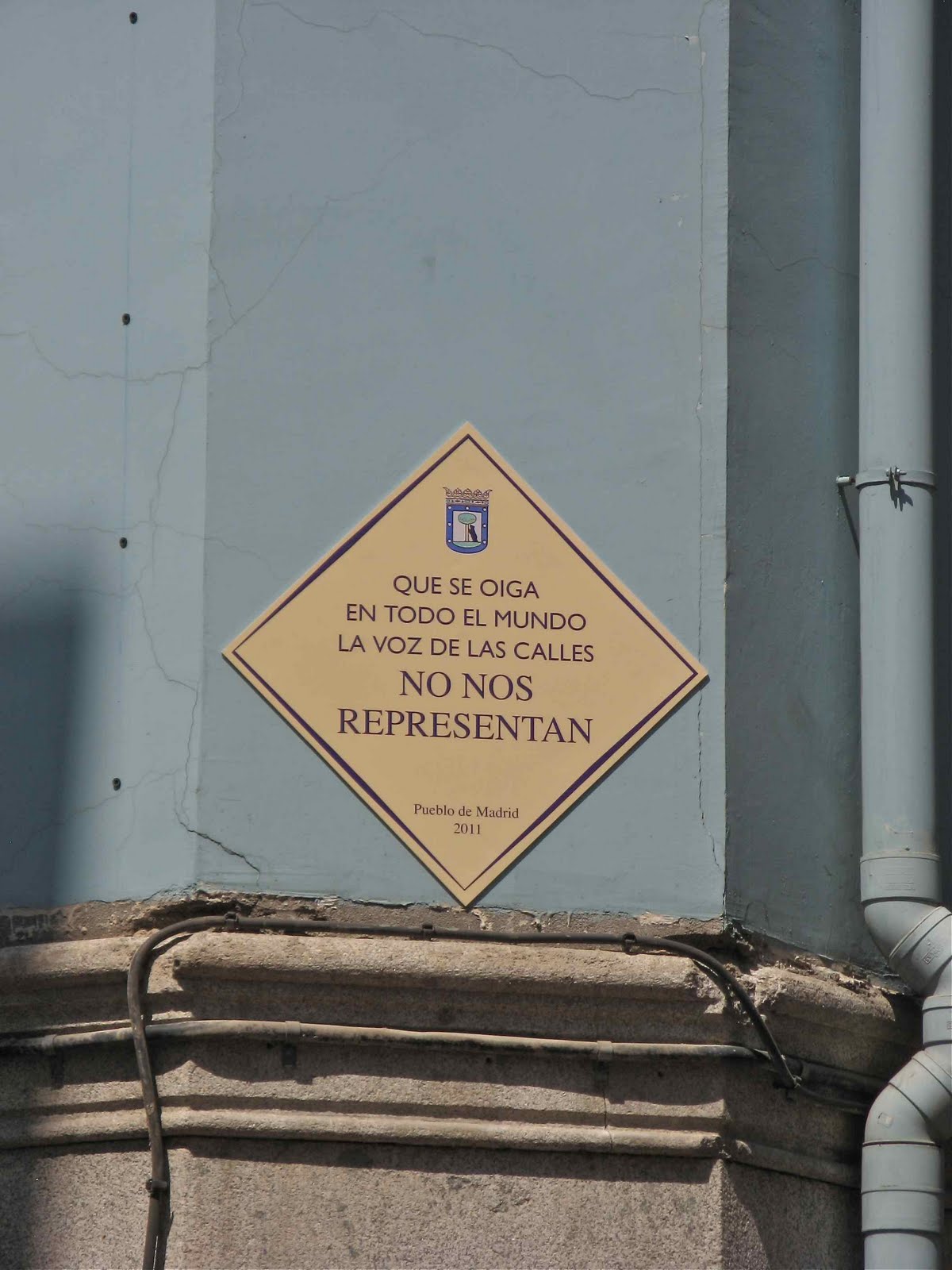
Anyway, enough about the squares. Let's take a walk around the wider, historic, barrio of Malasaña. Several buildings in the barrio display plaques commemorating famous people who have lived there. Including heroines of the 2 de Mayo uprising against Napoleon's troops, or feminist pioneers like Clara Campoamor.
More recently, there have been some new additions on different buildings around Malasaña - celebrating a different kind of uprising. My favourite combines the stencilled face of Aznar on the lamp post with the message on the wall.

Wednesday, August 03, 2011

La Plaza Tomada

It was a pathetic sight last night in Madrid. Circling the (police) wagons in the Puerta del Sol, all entrances to the square blocked by fully equipped riot cops. The police helicopter had been flying low over central Madrid for hours. At one point, over the heads of those in front of me, I caught a glimpse of the barrel of one of those guns the police use to fire gas canisters or rubber bullets. Preparing for a major assault, obviously. But it wasn't going to happen.

"Estas son nuestras armas" (these are our weapons) has become one of the standard chants of those taking part in protests organised by the 15-M movement. Shouted with your empty hands raised in the air. The authorities just don't get it, and the kind of over the top policing that converts many a peaceful protest into a public order problem found itself unable to cope yet again with a movement that refuses to play by the traditional rules. 

Last night, following the clearing of the square yesterday morning, the Puerta del Sol was closed to everyone except the police. Metro trains didn't even stop there. At first the police allowed some to enter the square, based it seems almost entirely on the appearance of the people who wanted to pass. Although well-dressed journalists were not admitted. Again they don't get it. Five "indignados" in a taxi dressed in business clothes were able to pass the barrier the police had put last week around the Spanish parliament. Eventually last night they decided they had to close the square to everyone. 

People came to protest against the eviction that had taken place earlier in the day. The authorities might have calculated that August was a good time to do it, but Madrid is no longer as empty in this holiday month as it used to be. Yet again a miscalculation by those in charge turns out to be a boost for 15-M. The streets around the Puerta del Sol filled with protesters, but the outcome wasn't going to be just a sterile stand-off for hours between demonstrators and riot police. Once again, the old rules didn't apply.

We arrived a bit late, to find crowds of people moving down the Gran Via, but not walking on the pavement. "Where are you all going?" we asked someone. "For a walk" was the reply. Half the Gran Via closed to traffic was much better than none of it. Down in Cibeles, where they are already building the stand for the Pope's visit, there were thousands of people and Real Madrid hadn't won anything. Nobody stopped long there, and soon the whole of the Paseo del Prado was occupied by protestors. The police were still busy recreating Custer's last stand inside the city centre.

Nobody gave any orders, another thing the idiots who govern us fail to understand. Everyone more or less knew where we wanted to go, so the Calle de Atocha ended up closed to traffic too as the ever bigger crowd turned back towards Sol, observed by bemused tourists. "Esto es lo que pasa por echarnos de la plaza" was probably the chant of the night. But Sol is not the only square in Madrid, after stopping for a while at the police line where the man with the gun was probably feeling anxious to test his weapon the protest moved onto the nearby Plaza Mayor to celebrate a mass assembly. Custer's men spent the night in the otherwise deserted square, protecting their wagons. They're still there this morning. Was it worth it?

Tuesday, August 02, 2011

Haven't You Got A Home To Go To?

As I write this post the police helicopters are still clattering over the centre of Madrid. They've been there since early this morning, as part of a huge police operation to remove all traces of the 15-M protest movement from Madrid's Puerta del Sol. All this overkill in reality is just removing the wooden information post that was set up when the camp was dismantled in Sol a few weeks ago. Today's operation follows a failed attempt to do something similar last week which ended with police charges against peaceful protesters in the Paseo del Prado. August, when the city is at its quietest, is no doubt seen as a good time for moving against 15-M after the relatively lighter attitude adopted by the authorities in May and June. After all, the Pope is due to arrive soon.

The Madrid police have been complaining recently about not being able to take on 15-M, following some incidents where protesters have interrupted the identity controls that police operate in selected Metro stations around the city. These controls are aimed against immigrants, as the targets are inevitably those who do not look like locals. Officially they do not exist, as the government has consistently denied that they take place. Photographers and journalists who have challenged this denial of reality have ended up being arrested and having their equipment seized. So we are left with the somewhat surreal situation where the police complain about not being able to carry out a task which their political bosses claim is not carried out anyway. Stopping something which doesn't happen can hardly be a crime?

Another cause of tension between protesters and police has been the campaign to stop people being evicted from their homes for mortgage arrears. Several judicial evictions have been stopped by protesters in recent weeks, leading the authorities to respond by massively increasing the police presence at these events. 120 police were used to evict someone owing a couple of thousand euros in Madrid last week. The cost of this operation? We're not entitled to know. In Barcelona, where the police are allowed to use as much violence as they like, we were treated to the ridiculous sight of the Mossos de Esquadra using ladders to force entry into an apartment and evict a family. Accompanied by the now familiar baton charges that they seem to use against any protest in the city. 

It's become almost commonplace for people to see a busy restaurant in Spain and remark "Crisis, what crisis?". There is a contrasting reality, the annual rate of home repossessions is running at around 90,000. Although the issue of Spain's mortgage legislation has been debated in recent months, the true scale of what is going on has only become apparent since 15-M took to the streets. Spanish mortgages promise a win-win situation for the banks who enticed so many people into huge mortgage commitments and who get to chase these same people for the remaining debt even after they have repossessed the property and in many cases sold it on at a knock-down price. There is no strong incentive for the banks to try and get value for money out of the property if they know they can continue to pursue the mortgage holder.

The government and the opposition Partido Popular have both come out in clear opposition to the idea that those who can't pay their mortgage can hand back the keys to the bank and clear the debt by doing so. Neither party is comfortable with any idea that involves doing something that the banks don't want to contemplate. It's just not enough that we all assume the debts of the banks. Some recent concessions on the amount of a person's salary that the banks can seize as part of the eternal mortgage recovery process were a nod in the direction of 15-M, but the movement will continue to highlight the cases of thousands of people being removed from their homes with no evident alternative and with only a debt to the banks to take with them. The victims of the crisis are no longer hidden from sight, and ever heavier policing is unlikely to solve that problem.