Wednesday, May 12, 2010

Then For Dessert We'll Have....Spain

That the Spanish government has been under heavy pressure in the wake of the "rescue" operation launched at the weekend by the EU can be in little doubt after the cuts in public spending announced this morning by Zapatero. It's now clear that instead of just being thrown directly off the cliff, we get offered the chance to see whether we can climb down it ourselves or be tossed over the edge in a slightly more selective fashion. Don't be ungrateful.

The cuts package, already dubbed the "tijeretazo", just helps to confirm something we already knew; that Europe's leaders continue to feel much more at home with the bankers than with their voters. The idea that sharp cuts have to be made now is nothing to do with sound economics, it's entirely down to short term market pressures and the refusal of the political leaders to live up to their promises of reform. The old maxim about what's good for GM being good for America was never true, and neither is its more recent cousin. What's good for the markets most definitely isn't good for the rest of us.

The bulk of the sacrifices will be borne by public employees and pensioners, with public investment also being slashed. They say the party is over, but the problem is that the consequences are being felt mostly by those who were never invited in the first place. Meanwhile the fiesta continues with an ever more exclusive guest list. The cheque-bebé for new parents may have been an unnecessary electoral gift, but then so was the abolition of the wealth tax. We've lost the cheque, but we won't be getting a tax back that would have helped in some way to redress the regressive nature of so many measures being taken. Of course, you can't imagine that the markets would react in the same way to deficit cuts achieved through butchering public services as they do to deficits which get narrowed by, say, taxing their activities.

This isn't so much voodoo economics, it's more slash and burn. It's a big mistake to call these anti-crisis measures, the most likely effect of them will be to return Spain to negative growth in the next few months. Nor is it any use asking what happens if the policy fails, as I've commented before the proponents of these kind of measures apply no failure threshold to their recipes and any subsequent lack of success in the economy will simply be attributed to the fact that there is still a doctor somewhere treating his patients for free. Or will it be because the, now imminent, McJobs labour market reform doesn't go far enough?

Meanwhile those who did best out of the boom years, and those who live on the profits of economic fraud, are allowed to continue their lives completely untouched by the cold winds of austerity. Over on Planet PP, the Partido Popular continues to play its ever more surreal game of opposing every measure the government introduces at the same time as they claim they can fund massive tax cuts by abolishing the Ministry of Equality! As those who have done very well out of other people's misery continue to do very very well, it seems only fair that the final word should go to the hungry. Let me offer this article from the Wall Street Journal as an antidote for those tales of market traders just doing their best to protect the savings of poor widows. A few people get together for dinner and decide to have Greece as one of the courses in between the lemon-roasted chicken and the filet mignon. For those who don't want to read the whole article the key phrase comes from Hans Hufschmid of GlobeOp Financial Services. "This is an opportunity...to make a lot of money".

Erlich, in El País.

Thursday, May 06, 2010

The Partido Popular's Solution To The Crisis

Sorry, I don't understand. What do you mean when you say "Is that it?".

Wednesday, May 05, 2010

The Sleepwalkers

You know those reports you see occasionally in the press about people drowning and how a crowd of spectators gathers to comment but no one does anything to help? That's an image which comes to mind when I think about the current assault by the financial markets against several European countries, most notably Greece. Except there is an important difference, apart from the spectators we have a group of people off to one side who place bets on whether those in the water will drown or not. Whenever they do, the same gamblers then select the next victim so that the spectacle doesn't end. If anyone looks like bucking the trend then they get their head held under the water for a while.

Greece is now being treated to modern capitalism's very own version of medieval medicine. The patients will not get better unless they are made much, much sicker than they were in the first place. You're looking a bit poorly, the best thing is for you to be left to bleed for a few years until it gets better. What happens if the patient dies? No problem, shit happens. Anyway, the next one will be along in a minute and payment was charged in advance. I was completely wrong when I thought that the next crisis would follow the previous one after a short interval, we are now living in the age of permanent recession as countries see any prospects of recovery smashed by the very same people who did so much to provoke the original crisis.

The commentators who support the gamblers like to entertain us with legends of Greeks who retire before they are old enough to work, but it won't be Greek pensioners who will be sipping mojitos on Caribbean beaches as a result of this crisis. It's those who are doing the betting who will enjoy the benefits of a comfortable early retirement. With the added advantage that they get applauded for it by the same people who criticise anyone else who gets such a privilege.

As we saw yesterday, all it takes is one fuckwit to start a false rumour, and a whole bunch of other fuckwits then spend the day doing everything they can to spread the same rumour. It all seems like lunacy, but there is a whole bevy of commentators and sleepwalkers who will, a posteriori, always find perfectly rational reasons to explain what has happened. Who cares whether it's genuine or not. The best thing about the current crisis for those busy earning a living out of it is that each further attack creates a state that can be used to justify the next one. "They're having problems paying their debts, so we have to make it more expensive for them to do it". "Oh, we've pushed them further into recession, better downgrade their credit rating".

I read a report a report last week of how traders had a "crazy, fun week" stuffing the future for yet another country. It's leading to a ridiculous situation where the prospect of an Argentinian style "corralito" becomes more real. More than anything because defaulting on debt will start to look more attractive for those running the countries concerned than implementing measures whose main effect is to prolong indefinitely the recession in the affected country. Of course such a corralito affects millions of people who might have a bit of money saved from doing real work, whilst the wealthy usually have their money stashed somewhere else. If anyone has seen any sign that the markets are not prepared to take their victims to that extreme then please point me to it. It's pointless to criticise the governments for not doing the right kind of reforms, the Greek example demonstrates that nothing will be enough whilst the opportunity to profit from the crisis remains.

So many millions of people now face a future even more uncertain than that which existed a few short months ago. Trapped into this situation by a political class that talked so smoothly of reinventing capitalism, but which has instead buckled at the first push from financial institutions rescued at public expense and who bring nothing to the table but who take so much away. Insanity in motion. They say it can be dangerous to wake up sleepwalkers, but surely not when they are about to take us all over a cliff?

Tuesday, May 04, 2010

Open Government....Madrid Style

Anyone seeking insight into obstacles facing the cause of open government in Spain could take as the perfect case study our beloved Comunidad de Madrid. Yesterday was just another normal day down in La Puerta del Sol. An opposition member of the regional assembly, José Cepeda, went to the archives department to exercise his right to see the documentation concerning the digital television franchises which Espe's administration has handed out in recent years to an assortment of her political allies. The archives are housed, rather spookily, in the same place where Franco's secret police used to hold their prisoners.

Cepeda had only lodged his request a year ago, so things were moving quite fast. Admittedly, he had already tried to see the documentation on Friday but had been refused on the all too reasonable grounds that he was accompanied by another elected member of the same regional assembly. Yesterday, he finally got to see the documentation....a lot of it. But then when he asked for copies of the parts that interested him he was refused on the grounds of "superior orders". So he stood his ground, and sent out a message on Twitter which rapidly started to spread. Finally, after 8 hours of waiting he was able to get the copies that he had requested. This, we need to repeat, is the case of an elected member of the parliament. Had it been a journalist or even, god forbid, one of the voters who had asked for access to the documents you can easily imagine that one year would turn out to be a short time in Madrid politics.

Meanwhile La Lideresa passed a happy Dos de Mayo celebration with the publication of an opinion poll showing that she is still on course to maintain her control of the region despite Gürtel, spies and her commitment to the maximum lack of transparency in government. Nevertheless, the poll shows her losing votes - something which is not to her credit if you take into account that the PP at national level has been steadily building an advantage against the government. The lost votes are not going to the PSOE or Izquierda Unida, the poll shows UPyD entering the regional assembly for the first time. Madrid after all being the stronghold for their kind of nationalist and centralist politics. Aguirre's supporters have tried to pretend over the last few years that she attracts more votes for the PP than Madrid mayor Gallardón and they have also made much of the fact that Mariano Rajoy has such a slender lead in the polls. Their arguments no longer look so solid if the Madrid PP vote starts to decline at a time when it should be hitting new highs.

Aguirre continues to benefit from a weak opposition, and we still don't know who will be her official opponent for the PSOE in next year's election. Regional PSOE leader Tomas Gómez has not made a strong impact, and didn't help his cause this week by sparking a row with the national party after he accused José Blanco of being too friendly to Aguirre. Internal PSOE dissidents can be threatened with disciplinary measures if they speak too publicly, but there have been outbreaks of criticism of the ineffective opposition campaign led by Gómez. Meanwhile, Izquierda Unida - which takes 10% of the vote in Madrid - has had its own problems. Inés Sabanés, who was very well respected beyond the confines of IU's supporters, was removed as candidate for the next elections in an internal coup launched by more hardline sectors. In neither party have calls for primary elections for party members to choose candidates been heeded. It's not just open government that we need.

Monday, May 03, 2010

Racism Takes Centre Stage In The Catalan Campaign

There are already some clear signs that racism will be part of the campaign in the Catalan elections to be held later this year. The most notorious example came in Badalona, where the Partido Popular distributed a nasty anti-Romanian leaflet. That the PP councillor behind this racist crap turned out to have a Romanian babysitter for his children should come as no surprise. It fits neatly into the "I don't think there should be so many of them here and what's more my Polish/Bulgarian/Romanian woman doesn't clean my house properly" kind of discourse.

It's not just about the PP either, because sadly we still haven't seen the end of the saga over the attempts in the town of Vic to exclude immigrants without papers from the municipal census. Although it appeared that Vic had fallen into line after the government told them that they couldn't do this, a statement from a European Union commissioner criticising Spain's policy led to Vic adopting a new measure. They threatened to report any illegal immigrant trying to register to the authorities. The intention is less one of upholding the law, it's much more about deterring immigrants from registering.

Vic has now been joined in this policy by another municipality, Sant Andreu de Llavaneres. This latter case gives the game away, it's a wealthy place with a low percentage of immigrants and where many of those from outside come from the European Union anyway. Despite this the PP and the conservative nationalists of Convergència i Unió have united to remind any illegal immigrants in the area that they are just there to tend the gardens of the richer inhabitants.

This kind of behaviour is nothing to do particularly with Cataluña, as I'm sure we'll find out next year when more regional elections are due to be held in Spain. It's just that the PP does so badly there that there is little they will stop at in return for a handful of votes. It's an ugly warning signal given that there has still been relatively little backlash against immigrants during the crisis. Anyone who has seen the dismal portrayal of immigration as only being a problem in the UK election debates will be aware of what some will try to do here.

Saturday, May 01, 2010

Madrid Gets The European Final It Didn't Expect

The car horns were hooting late at night in the centre of Madrid on Thursday. Of course it's not exactly an unfamiliar sound in the Spanish capital, but when so much noise is being made at such a late hour it's normally because Real Madrid supporters are celebrating one of their (increasingly rare) triumphs. This time was different however, it was the Atlético Madrid fans who were out making the noise even though their team had lost on the night against Liverpool. Over two legs in the Europa League semi-final Atleti came out on top and reached their second cup final of the season; they are already in the final of the Copa del Rey.

Nobody would have predicted such a situation at Christmas, but then Real were still in the Champions League and Atlético were close to the relegation positions in the Spanish Liga. Their league form hasn't improved that much, but in the cup competitions they have found a means of salvaging something from the season. It's a club with some talented players and disastrous management, and fans with a tremendous endurance and loyalty. It would be impossible to imagine Real Madrid supporters making the same sort of noise that Atleti's fans produced in Anfield, the fickle followers of Real rarely make that much noise when their team plays at home.

It's difficult not to enjoy the situation. As I walked through the recently pedestrianised square at Callao this morning I saw a bus that was parked offering the chance to anyone who wanted to hold the Champions League trophy. The final is to be held in Real Madrid's stadium later this month. There was already quite a queue but I didn't see Ronaldo or Kaka amongst those who were waiting. This after all was part of the plan behind the huge investment made by Florentino Pérez for this season, to win the trophy in their home city. It may have helped to heal the wounds of Madrid fans that Barcelona are not going to be in the Champions League final either. When the trophy was presented in the city a few weeks ago almost everyone was smiling except for Pérez, who sulked in the corner. Despite that small satisfaction, Real still face the possibility of not winning anything this season; if Barcelona don't slip up in the league.

We'll see whether Jose Mourinho comes to Madrid just with the hope of seeing Inter Milan win the final, or whether he will have more profound conversations with Pérez about terms and conditions. Entertainment will be guaranteed, at least off the field, if Madrid take him as their trainer. Meanwhile Atlético and their fans should enjoy the moment. The points gap in La Liga between the first and fourth places (which guarantee Champions League qualification) is currently greater than that between fourth and last. Those who are followers of teams other than the big two increasingly have to look to the cups for a bit of entertainment and excitement, because La Liga just hasn't got it.

Thursday, April 29, 2010

Nepal, Annapurna Circuit....Lower Pisang To Manang

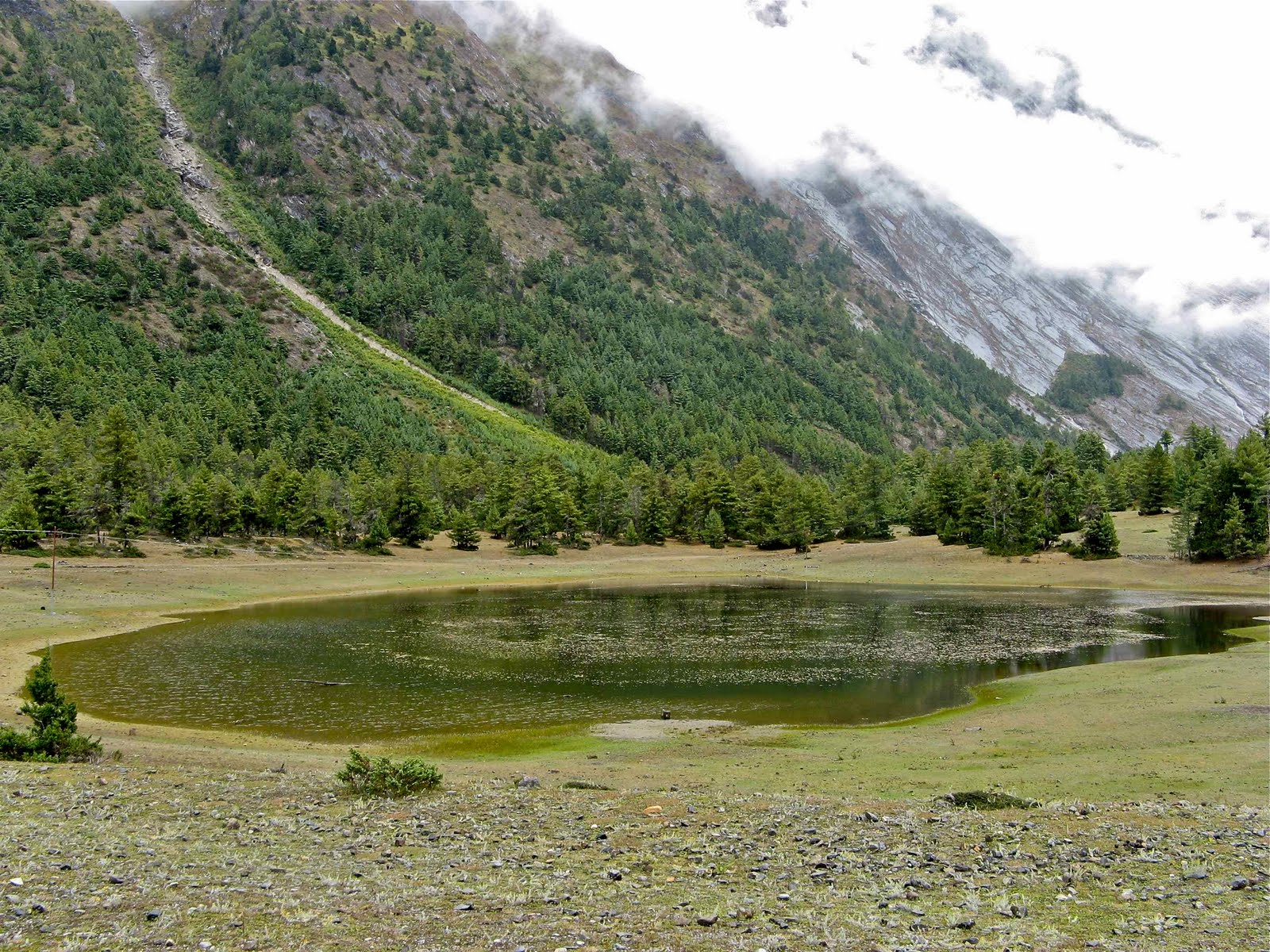
To get to Manang from Lower Pisang there are two options. You can carry on following the main trail which follows the valley floor, or you can take a higher route which passes through the village of Ghyaru. Even though the weather conditions were still not looking good as we had breakfast, we decided to go for the less busy higher route. It was a good decision, this would turn out to be one of the best days walking on the trek. First we headed up the hill towards Upper Pisang, from where we got a fine view of the village and the hotel where we had stayed below.


This is the Pisang village school, no educational luxuries here.


Leaving Upper Pisang behind we took a relatively narrow path through the pine trees. Visibility was mixed with banks of clouds marching up the valley. On a clear day we would have expected to see almost all of Annapurna 2 on the other side of the valley. It wasn't to be, this was about as good as it got.


It was disappointing not to be able to see the high mountains, especially as we were now so close. Despite this, the walk was still beautiful and we had some spectacular scenery.


After a while we started to climb again, and more steeply. This was the ascent up to the village of Ghyaru and it wasn't easy, even though the path zigzagged across the hillside. Having already had my altitude warning the previous day I was taking it relatively easy on the climb. On the way up I finally got an explanation for the chalky-grey colour of the river that we had been following since the first day of the trek.


In Ghyaru it seemed as if the whole village was out in their fields harvesting the buckwheat. It's a family enterprise with everyone assigned a separate task. Some of the fields seemed almost impossibly steep for cultivation, any tractors that they ever manage to get up here will soon tumble down to the valley floor.


The village itself is probably the nicest we had seen so far. If you take into account the stunning views that must be available on a clear day, it has to be a hugely impressive location and there is some accommodation here for those who want to stay overnight.


After Ghyaru the walk levelled off and we continued to follow the course of the valley. The landscape was changing again, what lay ahead of us was drier terrain evidently shaped by erosion.


We stopped for lunch in a nice place just before the village of Ngawal, a good choice for other reasons as it began to rain. From here the path descends again down into the valley. The pine woods thin out and we were surrounded by bare hillsides. Shortly after rejoining the main track we came to the village of Braga (sometimes written as Bhraka), built into the hillside and topped with a centuries old Bhuddist monastery which is well worth the visit.


Braga is close to Manang, and the valley widens out at this point. We passed herds of yak grazing, all of which stimulated the appetite a bit as our guide had told us of the yak steak we could be eating that night on arrival. The thought was enough to keep me walking.


It had been a relatively long day's walk by the time we made it to Manang, but very enjoyable, despite the weather. Whenever we had talked to Nepalis on the route they had asked if we were heading for Manang as if we would go no further, so it was something of a milestone on the circuit to get to this village. Manang lies at slightly over 3500 metres and we would spend an extra day here as acclimatisation to get ready for what lay ahead; the walk up towards the high pass of Thorong La.


View Nepal - The Annapurna Circuit in a larger map

Wednesday, April 28, 2010

Presenting The South Of Watford International Credit Ratings Agency

In the light of today's decision by Standard and Poor's to downgrade the rating on Spain's debt I've decided that this could be a good moment to set up my own international credit ratings agency. Now I realise that some will immediately object and wonder what qualifications I may have for adopting such a role? However, given that this question doesn't seem to be asked of the other operators in the market I see no reason whatsoever to respond on that issue.

In any case the rules are perfectly simple. Any financial services product from UK or US financial institutions, no matter how fraudulent and worthless it may be, is automatically given at least a triple A rating. If the investors in the package are pension funds or any other place where the little people put their savings then we can add a "+" to the rating because the effects of the scam will naturally be far wider and probably more profitable for those behind it. The same applies if the institution producing the package is at the same time betting against the success of its own product. No evident credibility problems there, so top rating.

With countries that have debts we adopt a slightly different tactic. Firstly, if it's the country where your agency is based or has significant commercial interests then just pretend that you haven't seen the debt. In other cases you start high and just work your way down notch by notch until the country in question starts screaming. It's best to start with the least powerful and then once the trend is established you can move on to the others - always of course obeying the key "don't piss on your own doorstep" rule.

Now of course you need to give a formal reason for each downgrade in a country's credit rating, but this is easy. I mean if S&P's can get away with using "sluggish economic growth" at a time when virtually every country is suffering from that problem then its hardly an issue. Apart from anything else, the effect of constantly downgrading the rating has the great virtue of creating even more new reasons for further downgrades. The next logical step will be to downgrade again, because - obviously - the poor credit rating has now made the country's debt even more expensive and harder to service; so a further downgrade is just inevitable. Inability to pay the debt because the credit rating has collapsed obviously has to be left to the end.

In the event of any objections that a country's debt has increased because of the consequences of the financial crisis, the best answer is simply "Crisis? Where?". We need to play hard to get on that one. Clearly any country that takes too long in privatising or simply closing key public services may need to be egged on a bit with sharper cuts in their ratings. I know it's a dirty job but someone has to do it. Then, at some point, just to show that those of us in the ratings business have a sense of humour too, we'll do another downgrade for some surreal reason such as concern about lengthening waiting lists in hospitals or because poverty is rising too much! Just for fun...and of course to make a profit on an honest days work.

Sunday, April 25, 2010

If One Fascist Group Should Accidentally Fall

The latest development in the case against Baltasar Garzón for his civil war investigation has been the exclusion of the fascist Falange from the case. For once the judge Luciano Varela got something more or less right when he described the Falange's documentation as mainly consisting of personal and political judgements that had no bearing on legal issues. Sadly, that's a verdict that could easily be applied to the entire case against Garzón, including Varela's own interventions. However, Varela did something very odd before dropping the Falange from the case. Instead of doing what judges would normally do in this situation, simply dismiss the case presented, he gave the fascists a day to adjust their documentation and advised them how to do it. Despite this irregular judicial assistance the Falange still wasn't able to do the job. Garzón's defence has promptly appealed against Varela's handling of this issue, claiming that it shows his lack of impartiality. At the same time the state prosecution service has also presented its arguments rejecting the case against Garzón. None of this is likely to prevent Varela from proceeding with his case, the Supreme Court judges seem determined to bring it to trial based solely on the accusations of the remaining plaintiffs. Despite the absence of the Falange, there are still two very right wing groups sitting on the wall.

Yesterday I attended the demonstration in Madrid organised in support of Garzón and justice for the victims of Franco's repression. It was a beautiful afternoon in Madrid and the route between Cibeles and the Puerta del Sol was a mass of republican flags, placards and photos of some of the victims. The march finished with speeches from various public figures including Pedro Almodóvar, Almudena Grandes and Reed Brody from Human Rights Watch. The speeches were followed by a dignified minute of silence in a packed Puerta del Sol. Below are some of the photos I took during the demonstration.


Saturday, April 24, 2010

Aguirre Still Plays With Three Men At The Back


Unable to hold out any longer against the growing public clamour for more posts about Esperanza Aguirre and events inside the Partido Popular, I think it's time for a Gürtel update. The big news of last week was of course the decision by Luis Bárcenas, the former national treasurer of the PP, to resign his seat in the Spanish Senate. Bárcenas had already resigned, for the second time in a few months, as PP treasurer and the party had even announced that it was no longer paying for his expensive lawyer. So attention had naturally focused on the fact that he remained as a member of the PP's group in the Senate, not least because it is this fact that offered him some degree of protection. By leaving the Senate he loses parliamentary immunity and his case is no longer heard by the Supreme Court.

On the same day as Bárcenas went, another of the PP's accused resigned from the national parliament. Jesús Merino also loses the right for his case to be heard by the Supreme Court and now the accusations against both men form part of the main Gürtel case handled by the Madrid courts. With these resignations the national PP could for the first time genuinely claim that they had acted against those facing such serious corruption accusations instead of just trying to claim that the police had faked the evidence. At the same time they passed the ball back to Esperanza Aguirre who, it should not be forgotten, still has in the regional assembly three representatives elected on the PP ticket who are facing charges. These three have been excluded from the PP group, but they continue to draw their salaries for doing nothing more than show up briefly at voting time to support the PP. Their party loyalty at least is not in question.

Aguirre has made a very determined effort to try and pretend that she has nothing to do with the Gürtel scandal, even though her administration awarded hundreds of contracts to the companies involved. It was her supporters in some of the right wing media who were also gunning for Bárcenas, and indirectly for Mariano Rajoy. At one point Aguirre even made the bizarre claim that she was the person who had originally uncovered the Gürtel scandal. This claim caused great amusement in Spain and led to the #aguirrefacts hash tag on Twitter becoming hugely popular for a series of ever more outlandish claims about things that Espe had discovered or invented. Even Aguirre herself, or more likely the person who pretends to be her on Twitter, joined in the fun. Apart from the continuing progress in the case in Madrid, attention now focuses on the Supreme Court's decision on whether to reopen the case concerning the Molt Honorable Francisco Camps. That decision comes on May 12th.


Thursday, April 22, 2010

Contra La Impunidad


With all the attention being focused on the possible trial of Baltasar Garzón, it's easy to forget the issues that lie behind the campaign to defend the judge. The Supreme Court has postponed the issue of which courts are competent to deal with cases concerning Franco's victims until after they have dealt with Garzón. Saturday's protests in Madrid and many other Spanish cities (see the map below from Público) are a reminder of what is at stake.

Tuesday, April 20, 2010

You Can Be Taught By A Nun But You Can't Wear A Headscarf

If, a couple of years ago, it was a school in Girona that provoked controversy for barring a Muslim pupil over the way she dressed, now it's the turn of Madrid. Najwa Malha, who attends a school in Pozuelo de Alarcón, has been barred from classes because she wants to wear a headscarf for religious reasons. The school insists that it has a regulation barring pupils from covering their heads and has not permitted Najwa to attend her lessons.

This is not even a case of someone being obliged to wear the headscarf against her will, Najwa has freely chosen to do it and some other pupils have also started doing so in solidarity with her situation. Today the teachers of the school have voted against any change in the application of the regulations and now the decision passes to the school's governing body.

The national government has made it clear that it regards the right to receive education as being paramount in this case, but the regional government of Madrid has not agreed; no great surprise there. An administration which dedicates much of its educational budget for the benefit of religious (Catholic) schools has no problem at all with pupils being force fed religion by the institution that is supposed to educate them. The crosses on the wall testify to that. If, on the other hand, someone practising a different religion chooses to wear a symbol of that belief then that becomes unacceptable.

Monday, April 19, 2010

A Very Laboured Reform

With so much expectation having been created around the issue of reforming the Spanish labour market, the government is struggling to find a set of measures which allows them to get support of both employers and trade unions. Add to this the very different ways in which things are presented to the financial markets compared to the presentation used for domestic consumption. That's why the draft reform proposals that were released last week could hardly be more ambiguous when it comes to the finer details of what may happen.

There are two potential strands to the reform being pushed by the government. One is to try and make an already existing type of contract the standard one for future permanent employees. This contract, which has a lower level of compensation in case of dismissal than that which many workers currently have, is already available for almost all categories of employees except male workers who are already in work. It hasn't been used very much and so the government sees making this available for all new contracts as one possible reform. The issue of how they get employers to use this instead of temporary contracts is still not clear.

Then comes what they call the "Austrian model". The floating of this proposal caught many people by surprise and in the end it hasn't had a very warm welcome from anyone. The idea is that each employee has a personal fund which increases throughout their time of employment and which is used to compensate them when they are sacked. If they don't get sacked at any point then the fund pays a supplement to their pensions on retirement. The idea is that workers carry the fund with them from job to job, so that they have no fear of losing compensation benefits by changing their employer.

It all sounds quite reasonable, but there is of course one tiny detail still to be resolved. Who pays? If the employers have to pay into the fund then they are going to object to the proposal, even though such an idea effectively spreads out the cost of dismissals over good times as well as bad. Obviously, if it's the employee who has to meet the cost from their salary then it represents a significant reduction in employee benefits and is very unfair to those who work in the worst paid and most insecure professions because they are unlikely to ever receive money from the fund when they retire. So much for putting an end to the "dual" labour market.

The government didn't want to focus too much on any of these details because it still doesn't have the agreement of either unions or employers. The warmest reception initially came from inside the employers association, until Gerardo Díaz Ferrán poured some cold water on the idea. Díaz Ferrán, whose own business empire is shrinking rapidly, is still sticking close to the positions of the Partido Popular who do not want the government to achieve any sort of agreement anyway. The PP loudly calls for a reform to be made, at the same time as it carefully avoids spelling out what they think such a reform might contain. We have our suspicions, but no confirmation will be received this side of a general election. In the end, if there is no other agreement, the government will probably attempt to impose the new standard contract.

Sunday, April 18, 2010

Avilés And Cudillero

Having done the warm up in Oviedo, it was on to Avilés. A town associated for decades with heavy industry, Avilés turns out to be a surprisingly attractive place. With much of the industry having gone, it is one of these towns that is forced to look to other ways of guaranteeing its future and the response from Avilés to Bilbao's Guggenheim is the Centro Niemayer.

We weren't there for culture though, unless it involved food and drink. Dinner was at Casa Lin, which may sound like a Chinese restaurant but it is in reality very Asturian. An unpretentious place that was recommended to us by some Asturian friends, they served us an impressive seafood platter. It even passed on South of Watford's MEC (Marisco Energy Coefficient), as there were things on the platter that justified the work involved in peeling them. The longaniza de Avilés also got a good reception.

After dinner we spent an enjoyable couple of hours in the town centre, which is where we returned the next morning before moving on. The weather was a bit better than in Oviedo. Avilés has the atmosphere of a "real" place, not affected by tourism. I liked it, a place to go back to.


Our next destination was Gijón, but we decided to spend the middle of the day in the small village of Cudillero further down the coast. The descent into Cudillero is claustrophobic, it's as if the people who founded the village didn't want to be bothered by anyone. Once you're down at the bottom there is a small port area and a few restaurants - just as well because we were looking for lunch. In summer I imagine this place is probably packed, there weren't many parking spaces free on the February day that we went there. The menu of the day in Cudillero turned out to be a bit disappointing, something which is frequently the case these days in touristy places. Anyway, we had places to go and things to eat, so after a short walk by the coast we headed for Gijón.


Saturday, April 17, 2010

The Spies Who Talked Too Much

Since we're already on the subject of the badly educated, it's time to catch up with what's happening in the case of the Countess and her "Gestapillo". According to the latest press reports, the police have now confirmed from mobile telephone records that the former Guardia Civil officers employed by Espe's administration were indeed following both Manuel Cobo and Alfredo Prada in the tense weeks preceding the re-election of Mariano Rajoy as PP leader. The judge handling the case now has to take a decision on whether to press charges for misuse of public funds - arguably a charge which could be used to close down much of the Comunidad's activities.

The Madrid PP have already changed their story several times on the spying scandal. In the case of Prada, when they eventually had to accept that the evidence of him being followed was unanswerable, the excuse was that the agents were engaging in special surveillance duties for security reasons. They will need a better excuse in the case of Cobo, because he holds no position in the Comunidad; being the deputy of Madrid's mayor Alberto Ruiz Gallardón. I am just thankful that Madrid doesn't have its own, official, police force. I shudder to think what it would be used for. If the spies hadn't used their mobile phones so freely there probably wouldn't be a case to answer.

Meanwhile the fallout from Cobo's attack on Aguirre's "vomitivo" positions will probably continue into next year. Indeed Cobo's status is now at the heart of the continuing war between Aguirre and Gallardón. Because Cobo has been suspended from membership of the PP for a year for speaking too freely, Aguirre supporters have been calling for him to be removed from his official positions in the Ayuntamiento. Gallardón just looks the other way and pretends he can't hear, and it is rumoured that Cobo will be readmitted back to the party before the year is up.

This is important because Aguirre may also try to remove him from the PP's lists for the municipal elections next year, something which will be made easier if Cobo is not formally a party member when they are drawn up. Aguirre's people control the PP in Madrid, the question is whether they will risk the confrontation that will follow any attempt to exclude Cobo. A key factor might be whether national leader Mariano Rajoy gets involved in the issue, although given his current reluctance to deal with anything difficult that doesn't seem very likely. I bring you this information with the sole objective of providing reassurance that Madrid continues to be run in the best interests of its citizens.

Friday, April 16, 2010

La Mala Educación

The other night, on the same day as the now famous meeting in defence of Baltasar Garzón, I did something a bit foolish; possibly even dangerous for my health. Anticipating the reactions to the criticisms made of the Supreme Court and the process against Garzón, I did a bit of zapping between the several very right wing digital channels which Esperanza Aguirre has so generously licensed for the enjoyment of all Madrileños. I went from Intereconomia to Libertad Digital, passing through Popular TV and Veo without of course forgetting to visit the well established favourite of Telemadrid.

Because I'm quite fond of boasting to those who don't live in Madrid about having such a high number of loony channels to watch it's possible that some people think I do this quite often. In reality I hardly ever watch any of them, I don't watch much TV at all in Spain. The novelty value of these channels wears off really quickly. Unless you are one of those who still lives in a state of permanent outrage because the PP isn't running Spain there is little reason at all to stop by at any of them. Almost all of them run what could be laughingly described as "debates" every night, where a gaggle of the extremely loud right wing will use up hours of (cheap) television time to always arrive at the same conclusion; Zapatero is to blame for everything.

I did it the other night because I wanted to see just how far these tertulianos were prepared to go in exhibiting absolute, abject hypocrisy when it comes to the issue of criticising the judiciary. They lived up to my expectations fully, there they were shouting about how outrageous it was for the left to criticise the fine judges of the Supreme Court and how justice must be allowed to take its course in the case against Garzón. Intolerable, anti-democratic and "guerracivilista" were some of the more polite terms used to describe those who oppose the way in which the Supreme Court is acting.

At this point we need a little exercise in historical memory. As some of you know I have blogged a lot about the conspiracy theories concerning the Madrid bombings. To do this I had to go fishing in some very murky waters and to read a lot of the things that were being said on the sites that promoted those theories. So I remember very well the respect shown by these people to the judiciary and the forces of law and order. The insults directed against the judges and prosecutors involved in the Madrid bombings case would fill several volumes. These were not just political insults either. When the investigating magistrate had to take some time off because he was suffering from glaucoma, our friends on the right engaged in some of the most vitriolic personal abuse you can imagine.

But then perhaps this was just an isolated bunch of extremists? Certainly not isolated, with powerful support in the media, the PP and the judicial governing bodies. The problem is that when any attempt was made to get the Consejo General del Poder Judicial to speak up in defence of the judges and judicial process over the 11-M investigation, the conservative bloc on that body always blocked such initiatives. Quite similar to what has happened with the Gürtel case, where the PP hasn't hesitated to repeatedly accuse both police and judges of fabricating evidence. I'm no longer shocked by this hypocrisy, but this week we have enjoyed a special festival of it. This attitude that perceives liberty of expression to mean that they can say or do what they want, and that everybody else should just keep quiet. Just like the old days.

Thursday, April 15, 2010

Nepal, Annapurna Circuit....Chame To Lower Pisang

The route from Chame to Lower Pisang took us above 3000 metres. The walk on this day was an easy one, mostly on broad forest tracks and with much of the route passing through a familiar looking landscape of pine forest. The river was never very far away.


Something was wrong, though, on this day. Although we could see something of the high peaks in the early morning, the clouds that moved in as we walked were not of the kind that just cover the tops of the higher mountains. As the morning progressed it started to rain, not hard but persistently. We couldn't see very much of our surroundings. At one point, as you get nearer to Lower Pisang, the route goes past a huge, bare, rockface named Swargadwari Danda. We could see little of it through the clouds but we could hear it, with the rumble of occasional rock falls. With the route being easy we weren't too affected by the bad weather, it just meant that we didn't stop very much.


Now it makes sense that if you have a Lower Pisang there should also be an upper equivalent. We opted to stay in the village at the bottom from which you get a fine view of nearby Upper Pisang anyway.


By now we were in a region of heavy Tibetan influence – evident in the architecture and the Buddhist symbols. In Lower Pisang, located at around 3200 metres, I suddenly got my first taste of problems with the altitude. I was just climbing the staircase to my hotel, not something that seemed very difficult, when I felt out of breath and realised that at this altitude I couldn't do things in a hurry.

There is little luxury about most of the hotels on the Annapurna Circuit, but none of them were bad. The rooms are simple and obviously you need the sleeping bag as the bed normally just has a single sheet. Showers can be available but there is question mark over whether it's a good idea to use hot water in places where firewood needs to be used to heat it. An increasing number of hotels claim to have solar powered showers, and in at least one where we stayed it was powered by butane gas.

The weather improved a little bit in the afternoon and the views cleared slightly, enough to see from our hotel the giant slab of rock that had been hidden from us back down the path. Before....


and after the clouds cleared....


The clouds didn't clear high enough to be able to see the 6000 metre Pisang peak, it's possible to do the trek to that mountain from here. Upper Pisang has a monastery which can be visited in the afternoon. Both the lower and upper villages are interesting for just wandering around.


With the weather not being good it was cold in the evening, I started feeling grateful for the warm sleeping bags that we had bought with us. Further back down the trail they had seemed a bit excessive for the night time temperatures we experienced, up here they were essential.


View Nepal - The Annapurna Circuit in a larger map

Wednesday, April 14, 2010

How Spain's Young Conservatives Keep Their Hands Clean

Until a few weeks ago I didn't know who Carlos Berzosa was. Maybe I'd seen the name at some point, but remembering who the rectors of Spanish universities were didn't find a space in my already overcrowded memory. Until a few students at Madrid's Complutense University decided to give their rector a hard time. Berzosa got shoved and shouted at over a proposal to end gender segregation in the university's residences, known as colegios mayores.

The opposition of the students to this measure puzzled many observers, who wondered whether the new generation was going to turn out to be more conservative than that of their parents - many of whom had done their best to circumvent the segregationist restrictions when they were students. Then the Comunidad de Madrid weighed into the argument, on the side of those who opposed mixed colegios. An argument broke out over the maintenance of the colegios with Aguirre's administration blaming Berzosa for not spending wisely, whilst the rector claimed that he didn't have sufficient funding and defended the autonomy of the university.

As a result of this Berzosa has found himself on the already lengthy list of enemies maintained by the Madrid PP and their media friends. Fast forward to Tuesday, when the meeting organised by trade unions in support of Baltasar Garzón was held on the premises of the Complutense, and with the presence of Berzosa. An attack on democracy is how the PP has described this meeting, obviously sensing a threat to their monopoly in recent years of character assassination of judges they don't like. Berzosa has been attacked for allowing it to happen on university premises and in recognition of his recent fame he now joins Garzón, Samuel Eto'o and the puppets of Los Lunnis in being on the receiving end of a legal action brought by Manos Limpias.

Now given that Manos Limpias is currently competing strongly with the Falange to be the favourite extreme right group for judges on the Supreme Court, there is every probability of yet another Spanish court being paralysed with this latest act of political revenge. Also included in the complaint made by the organisation is the former anti-corruption prosecutor Carlos Jiménez Villarejo, whose hard hitting speech in defence of Garzón yesterday has outraged the ultra right. It all goes to show that you don't have to do very much these days to get dragged before the judge


Yo Apoyo A Garzón / I Support Garzón

This post forms part of a simultaneous protest by bloggers against the judicial process that threatens to remove Baltasar Garzón from his position for having opened a case investigating the victims of Franco's repression. The growing campaign against this persecution of Garzón can also be followed on Twitter using the hash tag #apoyoagarzon.

This is not a situation where keeping quiet will help in any way. Garzón is accused of having knowingly exceeded his powers because he opened the lid on the circumstances that led to the death of tens of thousands of victims of Franco's dictatorship. Many of these victims still lie in unmarked graves scattered around Spain. Should he be removed from his position over this issue it will serve as a warning to the rest of the Spanish judiciary from those who seek to prohibit any attempt to come to terms with the past. Ironically, perhaps the Argentinian courts may take the issue further as a case is being presented in that country to investigate what the senior ranks of the Spanish judiciary seek to hide from view.

The way in which the case against Garzón is being handled by the investigating judge, Luciano Varela, is disgraceful. Varela accuses Garzón of having knowingly ignored the amnesty law passed in the 1970's and makes a whole series of unsubstantiated judgements about Garzon's intentions as well as attributing to Garzón judicial resolutions that were not even made by him. In the process of doing this he has committed a far more serious abuse of the judicial process than anything that Garzón could be accused of doing.

Varela systematically ignores international law on the issues affecting the (forcibly) disappeared and those who were subjected to other human rights abuses. Spain is a signatory of the major treaties on these issues and Varela is not entitled to ignore these treaties simply because it doesn't help his case. Additionally, he has rejected all requests by Garzon's lawyer to take testimony on the issues at the heart of the case. That means rejecting evidence from international experts and a point-blank refusal to consider the arguments of other Spanish judges who share Garzon's positions.

Such behaviour on the part of Varela makes it clear that the case against Garzón is not motivated by questions of law. Add to this the likely prospect that the court hearing the case will be headed by a judge who is a patron of the ultra right-wing DENAES (The Foundation for the Defence of the Spanish Nation). As if that isn't already enough, the accusing parties will be a collection of equally right-wing groups; including the fascist Falange. The stage is set for a dangerous judicial farce.

To find a parallel to this situation, you have to imagine a group of German Nazis being allowed to bring a case against a judge who had investigated the activities of Hitler's regime. The tribunal would be presided by someone who had sworn loyalty to that same Nazi regime. It wouldn't happen. It couldn't happen in Germany, but here in Spain that is the situation that is happening now with the case against Baltasar Garzón.


Monday, April 12, 2010

Egunkaria

On the face of it, it seems as if justice has worked as it should. Five directors of a Basque newspaper called Egunkaria were wrongly accused of being in the service of ETA, and today a Spanish court has absolved them of all charges. Surely no cause for complaint there, but when you look at the history of the case you come across something that can only be described as a massive and prolonged miscarriage of justice. Today Egunkaria makes headlines because of the verdict, but most of the long and sorry story of this case has been largely invisible, except to those who seek out information about it.

Egunkaria was originally founded in 1990, and was at that time the only newspaper that published entirely in the Basque language. Perhaps not surprisingly, the paper adopted positions that could be broadly identified with Basque nationalism, but not with support for ETA and terrorism. However, in 2001 a captain in the Spanish Guardia Civil presented a report to judge Baltasar Garzón claiming that documentation captured from ETA members could be interpreted to mean that Egunkaria had been set up to further the aims of the group. Garzón, who can legitimately be accused of overdoing it when it comes to tarring people as accomplices of terrorism, didn't bite on this particular hook and rejected the accusation.

That could, and should, have been the end of the matter. But the Guardia Civil officer persisted until he found a judge more receptive to his argument, and it was to be judge Juan del Olmo who took the decision to act and to close Egunkaria, claiming that it was created, financed and directed by ETA. We are now in 2003. Serious accusations of being terrorist accomplices were made against the directors of the newspaper. The years passed, and Del Olmo was unable to sustain a case proving the accusations used to close the paper. By 2006 the state prosecution service was already declaring that no evidence existed to substantiate the allegations of ETA support or control and called for the case to be shelved. Over three years ago.

Again, you might think that would spell the end of the process. But it continued, thanks above all to the fact that two of these ultra right-wing group who seem to make all the running in the Spanish legal system these days managed to keep the process going without the support of prosecutors. So finally, at the end of last year, the Egunkaria case came to trial with the accusation being presented by the Asociación Víctimas del Terrorismo and another group called, quite inappropriately, Dignidad y Justicia. The trial sessions did not last very long, but it was carried out on the principle of having a morning of hearings and then adjourning until the following week. Then it has taken another three months for the verdict to be issued, perhaps just a detail when you consider the overall time frame we are dealing with.

The verdict today dismisses the charges against the accused. Despite the careful legal language and the general unwillingness for those inside the system to ever admit mistakes, it is quite a damning document. It states clearly that the groundless prosecution has been based on the idea that anything to do with the Basque language or culture must also have something to do with ETA. The trial judge, Javier Gómez Bermúdez, comes close to suggesting that Del Olmo acted illegally in closing the paper. He even, and this is probably a first from a Spanish judge hearing a case linked to ETA, doesn't dismiss the accusations of mistreatment and torture made by the accused following their arrest. Gómez Bermúdez is certainly no radical, he was the judge who presided over the Madrid bombings trial. For that he is already on the hitlist of some of the right wing media who supported the 11-M conspiracy theories. His latest decision will guarantee his position on that list.

So there we are, surely justice has prevailed? Well no, a perfectly legal newspaper was closed years before the case affecting it came to trial and several of its directors have spent those years living under the shadow of being accused as terrorist collaborators. The closure can never be compensated, and justice still has a long way to go to right this situation. One of the ironies of the trial was that the groups presenting this bogus accusation attempted to frighten the court by claiming that huge compensation would have to be paid if the accused were not found guilty. But what price do you put on them being denied the right for years to freely publish in their language of choice?

Sunday, April 11, 2010

The Battle Of El Cabanyal

The timing was perfect. On the day that media attention in Spain was almost entirely focused on the release of the evidence in the Gürtel case, Valencia's town hall sent in the bulldozers to demolish houses in the historic barrio of El Cabanyal. It was an act of open provocation, there is still an unresolved dispute between the Valencian regional and city administrations and the national government over the plans to demolish a significant part of the Cabanyal. Although the demolitions were not inside the area covered by the government's protection, the intention was clearly to shift the balance towards destruction of the area by turning parts of it into a wasteland.

The residents of the area and their supporters protested against the sending of the bulldozers and the response was brutal on the part of the police sent in to protect the demolitions. Despite police claims that they faced aggression from the protestors, television footage has clearly shown people sitting on the road being beaten by police batons. Some of the victims of this violence have already lodged legal charges, and even the government is for once investigating the police actions. The situation is strange, the government is opposed to the demolitions yet much of the police violence came from the national force who are not under the orders of Valencian politicians.

The Valencian administration hopes to turn El Cabanyal into the latest construction based "pelotazo", once they get those awful old low-rise houses out of the way. The profits may not go to the Gürtel companies in this case, but there are other friends to take care of. The government has referred the issue to the Constitutional Court, but in the meantime the Valencian administration will seek to achieve what they want through facts on the ground.